Guide
Guide

Opening a personal bank account in Egypt without a fixed salary is possible, and far more common than most people realize. The bank doesn’t only look at a pay slip; it looks at who you are, where you live, and whether your money moves in a way that can be verified.
If you’ve been turned away from a branch before, you weren’t alone. In the World Bank’s Global Findex survey, only about 43% of Egyptian adults reported having a bank or mobile money account in 2024, which means roughly 57% did not. The Central Bank of Egypt (CBE) counts differently: its data on active accounts — which include wallets and Egypt Post accounts and prepaid cards — put financial inclusion at 77.6% of adults in December 2025. One is a household survey and the other is registered account data, so the numbers differ, but both show access growing fast. Several routes now exist for workers paid in cash, freelancers, market vendors, drivers, and anyone whose income doesn’t arrive on a fixed date each month.
IN SHORT
You can open a bank account in Egypt without a fixed salary. Basic financial-inclusion accounts can need little more than a national ID, while standard accounts usually ask for proof of address, an opening deposit and some evidence of income, such as a letter from your employer or a mobile wallet history. A Meeza prepaid card (issued on a national ID alone), a mobile wallet and InstaPay give you ways to start before you hold a full account. If your employer runs payroll through dopay, you also get a card and an account on day one.
What do Egyptian banks ask for when you open a personal account?
What banks ask for depends on the type of account you want to open. Basic financial-inclusion accounts, which several banks offer, can need only a national ID. Standard personal accounts usually ask for four things: a valid national ID, proof of where you live, an opening deposit, and some proof that money comes in regularly. A pay slip is only one of several ways to provide evidence for that last point.
A national ID is the document the bank starts with. It links your name and date of birth to a verifiable record, and CBE rules require banks to verify and record your identity before opening an account. If your ID has expired or your address on it is outdated, that’s the first thing to fix before walking into a branch. Renewing the ID at a civil-status office usually takes a few working days.
The second thing is proof that you live somewhere the bank can reach you. A recent utility bill (electricity, water, or gas), a rental contract with your name on it, or a stamped letter from your landlord works in most branches. Some basic accounts only ask for a bill if the address you want to use differs from the one on your ID. The bill doesn’t need to be in your name in every case. Some banks accept a household bill if you can prove you live at that address.
The third thing is an opening deposit. It differs by bank and account type. Basic accounts sit at the low end, with some needing an EGP-100 opening balance and others requiring no minimum balance. Standard and premium accounts ask for more, and that is where many workers without a fixed salary get pushed away. If a teller offers you a premium account, you can politely ask for the basic one instead.
The fourth thing is income evidence, and it applies mainly to standard accounts. Basic financial-inclusion accounts are built for people without a pay slip. For standard accounts, banks work within the CBE’s financial-inclusion framework, and the next section walks through what is typically accepted.
What counts as proof of income if you don’t have a pay slip?
If you don’t have a pay slip, banks in Egypt often accept a written letter from the person or company that pays you, mobile wallet statements (commonly three to six months), a tax card for self-employed work, or a record of regular incoming transfers. Requirements vary by bank, so ask your branch which they prefer. The goal is to show that money arrives in a pattern the bank can verify.
A written letter from your employer is the most common substitute for a pay slip. It states your name, the work you do, and how much you are paid each month. Even when the work is informal, a signed and stamped letter often goes a long way. If your boss isn’t familiar with the format, a short note on the company’s letterhead with their signature is usually enough for a basic account.
Mobile wallet history is the second route, and it has become more accepted as financial inclusion has climbed and e-wallets have spread. The CBE reports that registered wallets grew from 15.2 million in 2019 to 60 million by the end of 2025 (Business Today Egypt). A printout from your Vodafone Cash, Etisalat Cash, or Orange Cash wallet, or your InstaPay transfer history, showing several months of regular incoming transfers gives the bank a verifiable pattern, which is what it really wants to see.
For self-employed work (running a kiosk, working as a driver, doing repairs, sewing clothes from home), a tax card is the most relevant document. It registers you as a small business and gives the bank an external document to lean on. Many small businesses haven’t registered yet, often because the process feels heavy, so check with your local tax office what you need to apply.
Workers in agriculture, construction, hospitality, and similar sectors often combine two of these (a letter plus a mobile wallet history, or a tax card plus a utility bill) to build the file. That combination is usually stronger than any one document on its own.
How do mobile wallets and InstaPay fit into the picture?
A mobile wallet is a regulated account tied to your phone number that lets you send, receive, and store money. InstaPay is the app, licensed by the CBE, that moves money instantly between bank accounts, Meeza prepaid cards and wallets. Together, they are part of the layer that has brought tens of millions of Egyptians into the financial system in recent years.
A mobile wallet is the easiest first step for most people. You walk into a Vodafone, Etisalat, or Orange shop with your national ID, sign up, and your phone number becomes an account. The CBE regulates these wallets and reports that the number of registered wallets reached 60 million by the end of 2025, up from 15.2 million in 2019, with transactions of nearly EGP 4 trillion.
Once you have a wallet, you can receive money from family, from clients, from your boss, or from anyone who sends to your phone number. You can use that wallet to pay at merchants, top up your phone, pay bills, and withdraw cash at agent points. None of this requires a pay slip, and none of it requires a bank account first.
InstaPay is the layer on top. It launched in March 2022, was developed by the Egyptian Banks Company (the CBE’s technology arm), and runs over the CBE’s Instant Payment Network (Egyptian Streets). To register in the InstaPay app, you need a bank account or a Meeza prepaid card at a participating bank, linked to your registered mobile number. A wallet on its own is not enough to register, but wallet numbers can receive InstaPay transfers. The practical route would be: a wallet to receive money and build history, and a Meeza prepaid card, which needs only your ID, to use InstaPay.
A wallet doesn’t fully replace a bank account, though. The CBE sets daily and monthly limits on how much you can send, withdraw and spend through wallets and prepaid cards. For larger savings, for receiving an inheritance, for applying for a visa, or for taking out a loan later in life, you’ll still want a real bank account. The wallet is the bridge, not the destination.
Why is a Meeza prepaid card often the easiest first step?
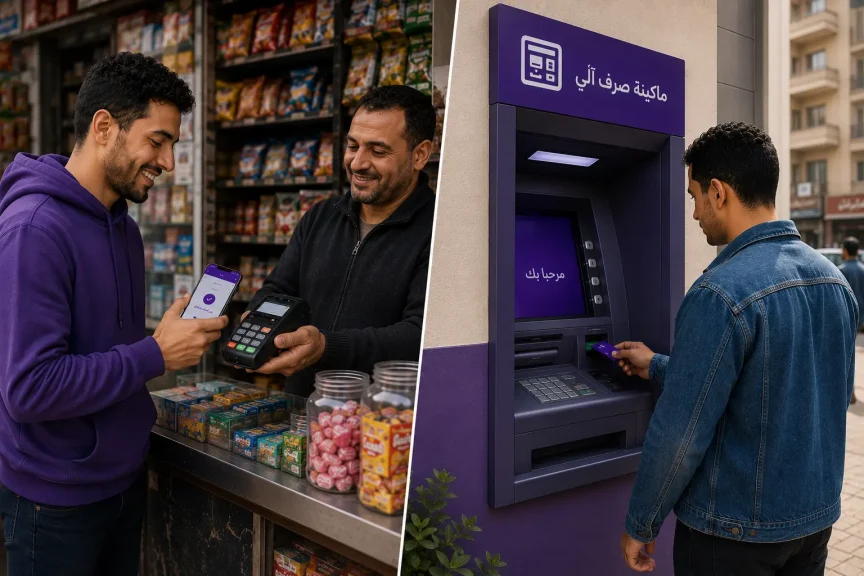
Meeza is Egypt’s national payment card (available to Egyptian nationals), backed by the CBE. A Meeza prepaid card lets you load money, withdraw at ATMs in Egypt, pay at shop terminals, and pay on local websites, and you don’t need a bank account to get one.
Meeza launched as part of Egypt’s national push for a more inclusive payment system, and the network now sits behind most government payouts (pensions, subsidies, salaries for public-sector workers) as well as a growing share of private-sector cards. For a worker without a fixed salary, the prepaid version is the easiest path into card payments.
You can get a Meeza prepaid card at participating banks with a valid national ID, and then load money onto it. It works like a debit card at ATMs and shop terminals in Egypt. The difference is simple: you can only spend what you load. If you load nothing, the card sits at zero. That makes it safer to start with and easier for the bank to issue. Because a Meeza prepaid card can be linked to InstaPay, it is also a way onto instant transfers without a full bank account.
Once you’ve used a Meeza prepaid card for a few months, you’ve built a small but real history with the bank that issued it. That history makes it easier later, if you want, to upgrade to a full personal account at the same bank, with the same staff who already know you and have dealt with you personally.
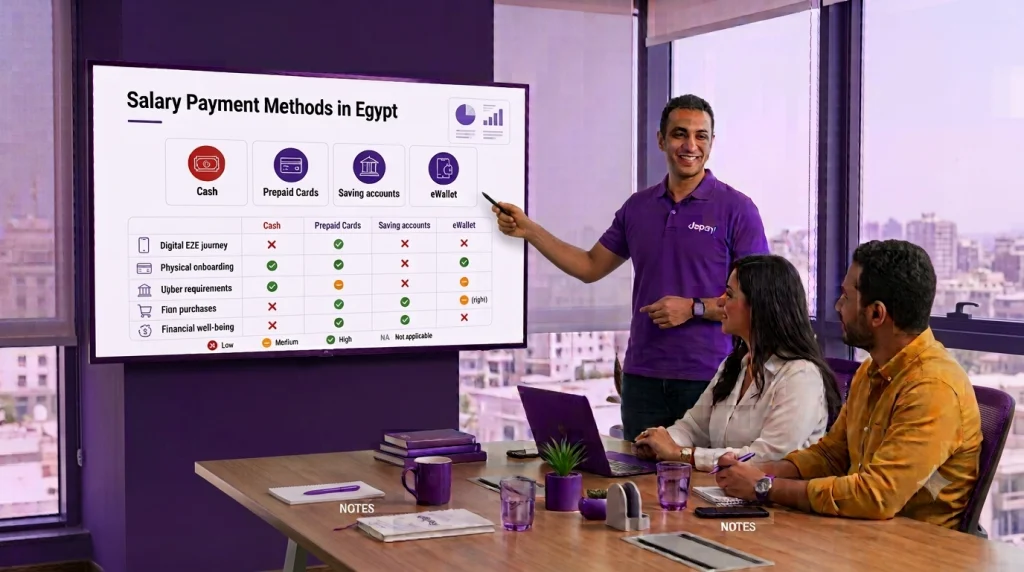
Here is how the four most common routes compare for someone starting from no account today.
| ROUTE | WHAT YOU NEED | TIME TO SET UP |
| Mobile wallet (Vodafone Cash, Etisalat Cash, Orange Cash) | National ID, phone number | Same day |
| Meeza prepaid card | National ID, then load money onto the card | One branch visit |
| Basic bank account | National ID; proof of address if different from your ID; opening deposit (from none to EGP 100 for basic accounts); income evidence only for standard accounts | Usually one or two branch visits, depending on the bank |
| Payroll card from your employer (dopay) | Your employer signs up | Card delivered to you on site |
How does getting paid through a payroll card open the door?
A payroll card is a card your employer hands you that comes with its own account, set up for you when you join. Your salary lands on it each month, you withdraw at any ATM, and you build a record of regular income that banks recognize. For workers paid in cash today, this is often the fastest way toward opening a real bank account.
If you work for a company in hospitality, manufacturing, retail, construction, or agriculture, your employer may already work with a payroll service that issues a card and an account for every employee on day one. That’s where dopay comes in. Across the businesses that have partnered with dopay, our on-the-ground teams deliver cards directly to staff, walk every first-time user through activation in Arabic and English, and the salary arrives on the card from the first payday.
For you as an employee, the practical difference is this: you no longer collect cash in an envelope on a known day each month. You see your pay in the dopay app, you withdraw what you need at any ATM in Egypt, you keep the rest safe, and you start to build a verifiable record of incoming income. That record is exactly what a bank wants to see if you later apply for a full personal account, a loan, or any other formal product.
FROM THE FIELD, WHAT WE SEE ON THE GROUND
A common scene at a new outlet: our delivery teams hand cards to a shift, our 24/7 customer care answers activation questions in Arabic, and within an hour the team has used the ATM next to the building for the first time. Many of those workers have never withdrawn money from an ATM before. A few months later, several of them open a full personal account at the bank that issued their card, because they now have a payroll history the teller recognizes.
The catch is honest: you can’t get a dopay account on your own. dopay is a service for employers. The way it reaches you as a worker is through the company that pays you. So if your workplace doesn’t run payroll digitally yet, the most useful first step is to ask your HR or your manager whether they’ve heard of dopay, or to forward them the dopay website so they can see the service for themselves.
What can you do this month to start the process?
Three steps cover most situations: make sure your national ID is current, open a mobile wallet, and ask a bank for a basic account or a Meeza prepaid card. If your ID is already valid, you can do all three within a few weeks, because basic accounts and Meeza prepaid cards need little more than your ID. A standard account that asks for income evidence is where wallet history helps, and that history takes three to six months to build, so start the wallet early.
Start with the ID. If yours is expired or carries an old address, visit your civil-status office (al-ahwal al-madaniya). Regular processing has been reported at around 15 days, with urgent options of about three days or even 24 hours for a higher fee. Fees and times change, so confirm them at the office. The bank will check your ID first, so it’s worth doing before you go in person.
Next, open a mobile wallet if you don’t have one. Vodafone Cash, Etisalat Cash, and Orange Cash all work in similar ways. Walk into a shop of your network with your ID. From that point, every transfer in or out is recorded, and after three to six months you have a real history you can show at the bank.
Then walk into a nearby bank with your ID. Ask specifically for a basic financial-inclusion account or a Meeza prepaid card, and bring a utility bill or rental contract in case your address differs from the one on your ID. If you want a standard account that asks for income evidence, bring your wallet history once it covers three to six months. If the teller pushes a premium product, you can politely say no and ask for the basic one again.
In parallel, ask your employer whether they pay through a digital payroll service. If they already use dopay, your card and account will come through your employer. If they don’t, the conversation itself is worth having, and you can point them to the dopay Knowledge Hub so they can see how it works for businesses their size.
 Blog
Blog