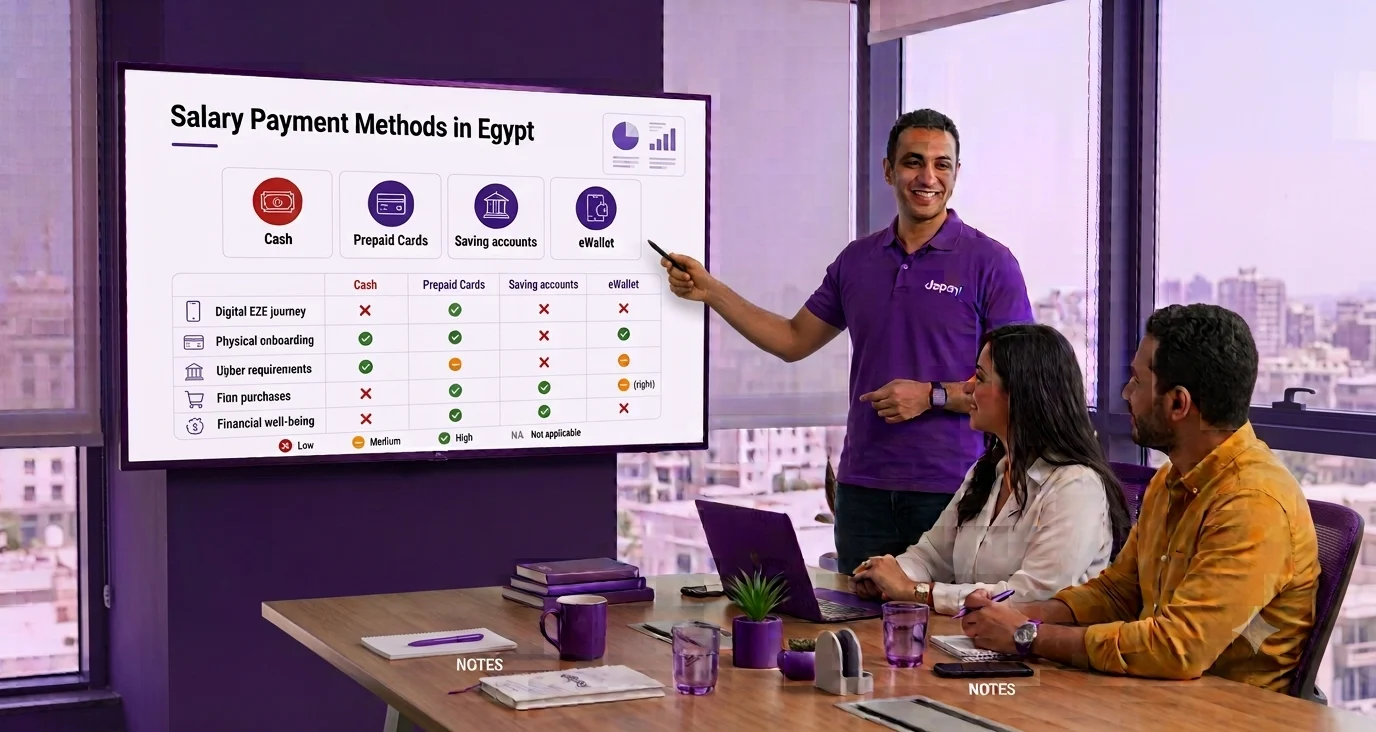
Payroll cards in Egypt are prepaid debit cards, branded to the employer, and loaded with each employee’s salary on payday. They give every worker a real card and a basic digital account, even when a traditional bank account is out of reach.
We’ve looked at where the category actually fits inside an Egyptian SME, where it replaces cash without disruption, and where a regular bank transfer to an existing account is still the more convenient answer.
IN SHORT
A payroll card in Egypt is a prepaid card issued through the employer and loaded each pay cycle with the worker’s salary. The employer gets faster disbursement, a full audit trail, and less cash on premises. The worker gets a real card, ATM access, and a starting point for everyday digital payments. Payroll cards are the right tool when the workforce includes employees without a personal bank account, and a poor fit when everyone is already on payroll bank transfer.
THE CATEGORY
What is a payroll card and how is it different from a regular debit card?
A payroll card is a prepaid card issued through the employer, loaded with the employee’s net salary each pay cycle, and onboarded with simplified KYC. It looks and behaves like a normal debit card at the ATM and point of sale (POS), but the account sitting behind is a prepaid wallet rather than a full personal current account.
A payroll card sits in a regulated category called prepaid instruments. In Egypt, prepaid cards are governed by the Central Bank of Egypt (CBE) and run on the same payment rails as bank-issued debit cards. Most payroll cards in the local market are issued on Meeza, the domestic scheme operated by the Egyptian Banks Company, which means they work at every Meeza-enabled ATM and POS terminal across the country.
For the worker, the everyday experience of having a payroll card is almost identical to a regular debit card. Workers insert the payroll card at an ATM, enter a PIN, and withdraw cash. They tap at a restaurant, a supermarket, or a fuel station. They use the card number online. What’s different is what happens behind the card. A regular debit card is tied to a full personal current account the worker opened individually, usually with a salary letter and a stack of documents. A payroll card is tied to a prepaid wallet set by the employer, often in a single on-site enrollment session that takes around 15 minutes.
The simplified KYC profile is what makes the category exist at all. Egyptian regulators have built a graded KYC framework that lets lower-balance prepaid accounts onboard with lighter documentation while keeping the card inside the formal financial system. That trade-off is the whole point of a payroll card. It reaches employees who don’t yet have a personal bank account on day one of the job, without sending HR on a months-long chase for documents that don’t exist.
THE CYCLE
How does a payroll card actually work in an Egyptian pay cycle?
Each pay cycle, the employer uploads a payroll file that lists every employee and net salary. The issuer credits each individual card account on payday. The worker receives a notification, taps the card at POS, or withdraws cash from an ATM. The employer gets one reconcilable record of every disbursement.
The mechanics are simple, even if the first cycle takes some getting used to. HR locks the monthly register, finance approves the total, and the issuer pushes the net amounts onto the individual prepaid card accounts in one batch run. The funds are reflected in each card right away. The worker doesn’t need to visit a branch on payday, and HR doesn’t need to chase missing IBANs.
For the worker, the first onboarding usually happens on site. An issuer representative or the HR lead collects a national ID, registers the worker in the issuer system, and hands over the card (or activates a card that was pre-produced). Activation involves setting a PIN and downloading a companion mobile app. In practice, the full process for one employee fits within a fifteen-minute slot, and the line moves quickly once the first three or four people are through.
After payday, the worker uses the card the way they would use any other debit card. According to the CBE, account ownership across the population has climbed toward 71% when wallets and prepaid cards are counted alongside bank accounts. Payroll cards are a meaningful part of that broader picture, particularly in sectors where bank-account ownership specifically remains lower.
CARD VS TRANSFER
How is a payroll card different from sending salary to a bank account?
A bank transfer to a personal bank account is an option that assumes the worker already has a bank account and knows its IBAN. A payroll card removes that assumption. The card and the underlying account are provisioned by the employer on behalf of the worker, in a single coordinated motion.
The contrast is clearest during onboarding. With a per-employee bank transfer, HR collects an IBAN from each worker, validates it, and adds it to the payroll file. Any IBAN that’s missing, mis-entered, or tied to an account that’s gone dormant turns into a follow-up call the night before payday. For workforces where 30% or more of new hires arrive without a personal bank account, that collection step quietly absorbs hours of HR time every month, and the pattern we keep seeing is that it never gets faster on its own.
With a payroll card program, the issuer becomes the account provider. HR sends one onboarding list, the cards are produced or activated, and the worker walks out of the enrollment session with a working account already in their pocket. The same logic carries over to mid-cycle hires. A new joiner who starts on day 14 of the cycle can be added to the next payday without anyone hunting for a bank statement that won’t arrive in time.
| Dimension | Cash payroll | Bank transfer to personal account | Payroll card |
| Worker needs existing bank account | No | Yes | No |
| Cash on premises | High | None | None |
| Audit trail per disbursement | Signature sheet | Bank statement per worker | One register, timestamped |
| Onboarding effort for HR | Low for HR, high for ops | IBAN chase per worker | One enrollment session |
| Worker upgrade path | None | Already a full account | Upgrade to full account later |
TWO SIDES
What does the employer get, and what does the worker get?
For the employer, a payroll card program turns payday into a single approval and one reconcilable register. For the worker, it is a real card on a real network, with ATM access on payday and the option to start paying digitally instead of withdrawing the full balance at once.
On the employer’s side, three operational gains usually show up across the customer base. Disbursement collapses from hours of cash counting into a single batch approval. Cash on premises drops to zero on a known date, and that’s a security exposure most insurers already price into the premium amount. The audit trail becomes one timestamped row in the payroll register per employee per cycle, reconcilable against the bank statement and usable as evidence during a labor inspection or a social-insurance review.
The cost of the process also shifts. The hours that HR, the GM, and the accountant used to spend on cash payday move back to other work. Card production and delivery are typically built into the payroll-card program, either absorbed by the issuer or charged at a predictable per-card fee that the employer can model in advance. International Labour Organization data on Egypt shows informal employment sitting above 60% of non-agricultural employment, which means digital disbursement also strengthens the employer’s compliance position on declared wage payments.
From the worker’s side, the headline is dignity and access. The card arrives on day one of employment, not after a six-week wait for a bank to open an account. ATM access on payday is the same as any other cardholder. The companion app, when one is provided, lets the worker send money to family, top up airtime, pay merchants, and check the balance without queuing at a branch.
There’s also a quieter benefit that doesn’t always show up in the pitch deck. A payroll card creates a record. For workers who have never had a documented salary history, that record can later support an upgrade to a full personal bank account, a credit application, or a tenancy. The card is the starting point, not the ceiling.
 Guide
Guide