

In 2024, a Cairo-based hospitality group was losing three employees every month. By Q2 2026, monthly departures had dropped to less than one after the group implemented earned wage access (EWA). The only thing that changed was when employees got paid.
That single shift points to a retention paradox facing Egyptian employers right now. Unemployment sits at a historic low of 6.2%, yet more than 60% of employees across the MENA region say they are considering leaving their jobs. The challenge for HR leaders isn’t finding people to hire, it’s keeping the people they already have. And for mid-market companies competing against larger employers with deeper pockets, the usual retention drivers — bigger raises, nicer offices, and more perks — often aren’t realistic.
This article looks at how Egyptian companies in retail, hospitality, and manufacturing are using earned wage access to bring down turnover, with real numbers from 2026.
In Short
More Egyptian companies are starting to implement EWA practices to break the cycle and retain their best employees. In the face of inflation, currency devaluation, increasing financial pressure, and dwindling staff morale, it is pivotal for employers to adopt retention strategies that tackle employees’ real needs and, at the same time, don’t cost the business an arm and a leg. 2026 figures show that EWA is one of the best tools that checks every box and achieves 10–30% turnover reduction.
What Earned Wage Access Actually Is (And Isn’t)
Earned wage access, or EWA, lets employees draw on wages they have already earned before their scheduled payday. It is not a loan: there’s no interest charged, no credit check, and no debt created. The amount an employee accesses is simply deducted from their next regular payroll run. Depending on how a company sets it up, the employee pays a small transaction fee, or the employer covers it as part of the benefit.
In practice, it looks like this: a factory worker earns EGP 300 in wages on Monday. Instead of waiting until the end of the month to see any of that money, she can access EGP 150 of it on Tuesday — money she has already worked for, just made available sooner.
Why this matters specifically in Egypt. The standard monthly payroll cycle creates a 30-day cash flow gap between the work an employee does and the money that reflects it. That gap becomes far more painful when inflation is eating into what a salary can buy — Egypt saw inflation of roughly 28% in 2024 — and when a large share of the workforce operates without a financial safety net. More than 60% of workers in the informal sector have no cushion to fall back on. When cash runs short before payday, employees often turn to informal borrowing, late fees on bills, or bank overdrafts to bridge the gap.
EWA breaks that cycle without turning the employer into a lender. It doesn’t touch salary levels; it changes the timing of when employees can reach the money they’ve already earned.
This distinction matters because of what Bayt.com’s MENA salary research found: salary is the single biggest driver of employee loyalty, cited by 54% of respondents, yet 66% of employees received no raise in 2024. Most companies can’t solve the loyalty problem by raising pay. They can solve the timing problem.
The Retention Problem EWA Solves
Financial stress is driving people toward quitting and pursuing other opportunities. PwC’s 2026 Employee Financial Wellness Survey found that 59% of employees are stressed about their finances, and 76% say that stress affects their productivity at work. Separate research from Rain found that 56.6% of frontline employees would stay in a job longer if they had faster access to their pay, and one in four had missed a day of work because of financial stress. In Egypt, where inflation and currency pressures compound on top of these baseline stressors, the effect is amplified.
The cost of this to employers is not abstract. A 2025 Valoir report put the productivity loss from employee financial stress at $1.1 trillion a year globally, with affected employees spending an average of 3.3 hours a week managing personal finances during work hours — an estimated 8% hit to productivity.
The hidden cost of the 30-day wait. A 2025 EBRI/Fourth case study in the hospitality sector found that employees use EWA primarily to cover bills (60%) and emergencies (46%). Among those who used it, 57% said it helped them avoid borrowing from family or friends, 40% avoided late fees, and 32% avoided a bank overdraft. The pattern behind these numbers is simple and important for retention: when employees can’t make it to payday without a financial hit, they will leave for the next employer that offers faster access to pay — even at the same salary.
Why traditional retention tools miss this. Salary increases help, but they aren’t always on the table, especially with two-thirds of employees having gone without a raise in 2024. Training and career development programs take months or years to show results. Office perks and other add-ons don’t help someone cover a doctor’s bill this week. EWA is different because it targets an immediate, recurring pain point — the wait for money already earned — at little to no cost to the employer.
Real Results: What the Numbers Show
Global benchmarks are consistent. Instant Financial reports a 27% reduction in turnover among companies offering EWA, with employees staying two to three times longer than non-users. Tapcheck’s data shows a 13–27% average turnover reduction. Netchex reports retention improvements in the 10–30% range. Harvard Business School research adds academic weight to these figures, finding a statistically significant retention improvement associated with EWA access, with the strongest effect among the lowest-wage earners and women. Taken together, EWA providers commonly report retention gains of 15–25% in high-turnover industries within the first year of implementation.
The ROI math, applied to an Egyptian mid-market company. Consider a company with 50 employees and 20% annual turnover (10 departures a year). Replacement costs typically run 50–100% of an employee’s annual salary. At an average salary of EGP 144,000, that puts the cost of each departure at EGP 72,000–144,000, or EGP 720,000–1.44 million a year in total turnover cost.
Now apply a conservative 20% reduction in turnover from EWA (two fewer departures a year). That alone saves EGP 144,000–288,000 annually. Against that, the cost of EWA to the employer is often close to zero. Netchex frames this trade-off starkly: a replacement cost of $2,000–$5,000 per departure versus an EWA transaction cost of $0–$2. Even under conservative assumptions, the return on offering EWA is significant.
Results vary by industry, but the direction doesn’t.
- Hospitality: The EBRI/Fourth study found 75% of EWA users in hospitality access their wages weekly, and 41% draw $100 or more per access. Hospitality also carries turnover rates that can approach 100% annually, so even a 10% reduction represents substantial savings.
- Retail: Retail holds 21% of the EWA market — the largest share of any single sector, according to Market.us. Variable shift patterns and hourly wages make early access especially valuable for retail staff managing unpredictable schedules.
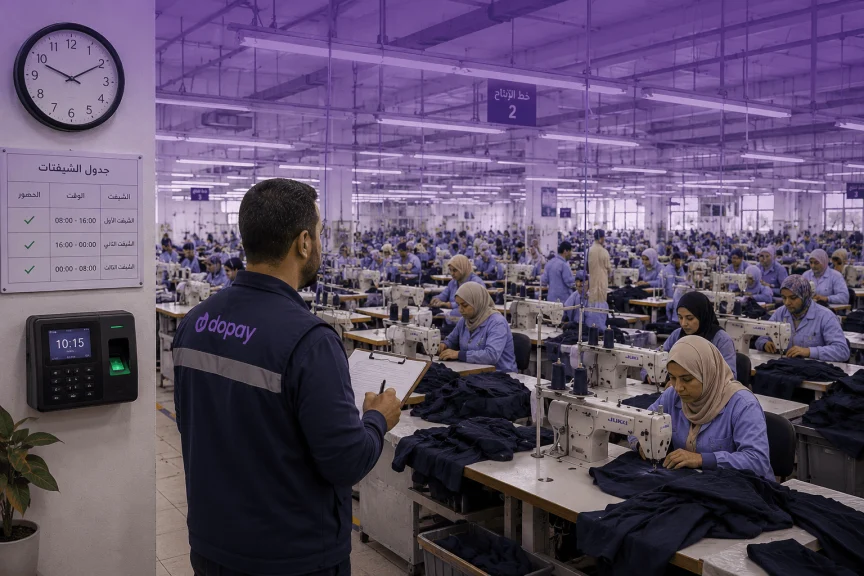
- Manufacturing: Shift-based work and bi-weekly pay cycles create their own cash flow gaps for hourly workers. EWA gives employees a buffer without requiring any change to the underlying payroll structure.
How Egyptian Companies Are Implementing EWA
The implementation reality is simpler than most HR leaders expect. SHRM MENA research found that 82% of employers describe their EWA rollout as easy, and 71% report measurable improvements in HR KPIs after implementation. EWA integrates with the payroll system a company already uses; it doesn’t change the pay cycle or require new accounting processes. Employees self-serve through an app, and the amount they access is deducted automatically on the next payday.
What’s required to get started. The one non-negotiable is a digital payroll foundation — EWA cannot run on cash wages, because it depends on real-time, integrated time and attendance data to calculate what an employee has actually earned so far. Beyond that, companies need clear communication to employees about how the benefit works, and a simple onboarding flow. Most employees who use EWA activate their access in minutes. For companies already running digital payroll, adding a tool like EarlyPay doesn’t require a separate system: it plugs into the infrastructure that’s already there.
What employees actually do with early access. The EBRI data shows 75% of users access their wages weekly, with typical draws of $50–$100. The top uses are bills (60%), emergencies (46%), and everyday expenses (53%) — not discretionary spending. This is worth addressing directly, because it’s the question every HR leader eventually asks: does giving people access to their money early lead to overspending or dependency? A 2025 University of Oregon study looked specifically at first-time EWA users and found their net monthly income rose by 11.5% — about $334 a month — with no corresponding increase in overdrafts, debt, or overspending. EWA appears to replace expensive stopgaps, like payday loans and late fees, rather than create new financial habits.
Making the Case to Leadership
The CFO conversation should start with cost, not culture. Lay out the current turnover cost: departures multiplied by replacement cost, calculated the same way as the ROI example above. Then show that even a modest 10–15% reduction in turnover translates into meaningful savings, at a tool cost that is typically zero to the employer. There’s no cash flow disruption either — the business still pays employees on its normal payroll cycle; the EWA provider fronts the early access and is repaid through the standard payroll deduction.
The CEO conversation is about competitive positioning. Younger job seekers increasingly weigh EWA availability when choosing an employer — Forbes has reported that 75% of millennials factor it into job decisions. In a labor market where 60%+ of MENA employees say they’re open to leaving, offering EWA is a visible differentiator. It also supports compliance and documentation under Egyptian labor law and reduces the volume of informal, ad hoc salary advance requests that HR and finance teams otherwise have to manage manually.
The HR pitch ties it together. EWA cuts down on the administrative burden of one-off advance requests, gives HR a measurable KPI to track (retention, absenteeism, employee sentiment), and strengthens recruitment messaging. It also answers a demand HR already knows is there: CAPTRUST’s 2026 survey found 85% of employees want their employer to offer financial wellness resources. EWA is a concrete, low-cost way to deliver on that.
Getting Started with EWA in Egypt
- Confirm your digital payroll foundation. EWA depends on integrated time and attendance data — cash-based payroll won’t support it.
- Calculate your current turnover cost. Multiply annual departures by your average replacement cost to get a baseline figure to measure against.
- Evaluate EWA providers. Compare integration ease, fee structure, and the employee experience of the app itself.
- Pilot with your highest-turnover department. Hospitality front-line staff, retail floor teams, or factory shift workers are typically the best starting point.
- Measure and expand. Track retention, absenteeism, and employee feedback, then roll out more broadly once the pilot shows results.
For companies already running digital payroll, dopay‘s EarlyPay offers a direct path in: it’s built to integrate with digital payroll from day one, so there’s no separate system to set up. It’s available in Arabic and built for the realities of the Egyptian market.
Conclusion
Earned wage access isn’t a perk: it’s a retention tool with measurable ROI. Companies that implement it report turnover reductions of 10–30%, with the strongest results showing up in the industries that need it most: hospitality, retail, and manufacturing. For Egyptian companies caught between inflation-driven employee stress and a labor market where most workers say they’d consider leaving, EWA solves a problem that a salary increase alone can’t: the 30-day wait for wages employees have already earned.

 Guide
Guide