Guide
Guide

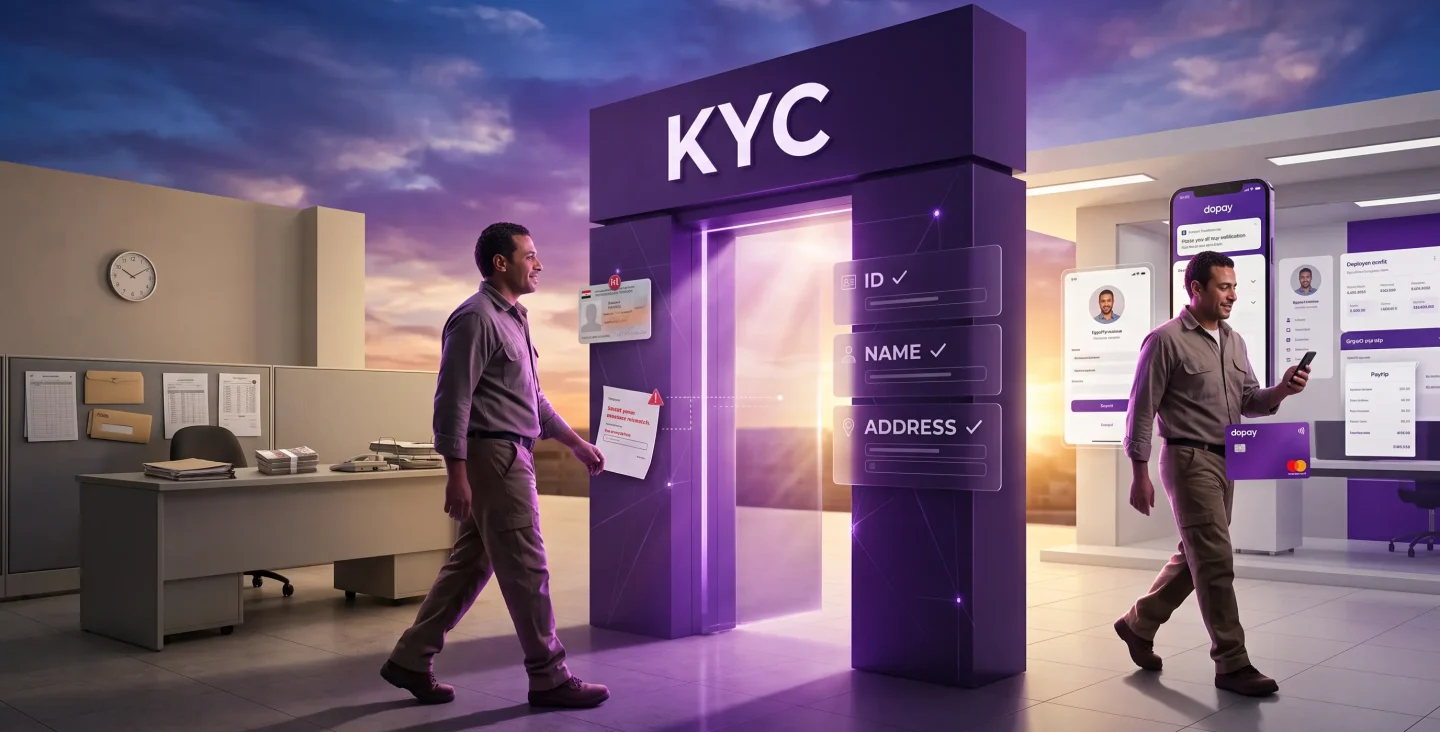
Understanding KYC requirements in Egypt is the first step to moving a frontline worker off cash pay and onto a real bank account, and it’s a shorter list than it sounds. The Central Bank’s simplified KYC tier asks for: a national ID, a confirmed mobile number, biometric verification, and an address reference. Once that account is open, it belongs to the worker for good, not the job. Here’s what onboarding actually requires under Egyptian KYC rules, and how long it really takes from hire to active card.
In Short
Egyptian KYC for a basic payroll account asks for a valid national ID, a recent photo, a confirmed mobile number, and an address reference. The employer collects this evidence and hands it to the issuing processor. The most common blockers are expired IDs, name mismatches, and missing address proof.
What does Egyptian KYC actually require for a basic payroll account?
Egypt’s risk-based KYC approach allows lighter verification for lower-risk accounts like basic payroll. That’s because the salary is regular and modest, and the account is opened with the employer’s involvement. The full bank-grade KYC that applies to high-balance accounts isn’t the standard the employer has to clear here.
Four pieces of evidence carry the weight. The national ID card, issued by the Civil Status Department, is the primary identity document. A current photo of the holder confirms the ID belongs to the person on the payroll. A mobile number, confirmed by a one-time code, anchors the digital account. An address reference, which can be an employment letter or the address printed on the national ID, satisfies the geographic record.
For foreign nationals working in Egypt, the document set shifts. A passport replaces the national ID, and a valid work-permit reference number sits alongside it.
Most workers in Egypt are Egyptian nationals, so the national-ID route is the dominant one in practice.
The Meeza network, Egypt’s domestic card scheme operated under the Central Bank’s umbrella, accepts the simplified KYC tier for payroll card issuance. That alignment is what makes day-one card delivery a realistic operational target. The processor and the network read the same documents the employer already collected, with no parallel branch paperwork to chase.
What does the employer collect versus what the issuing processor collects?
There’s a clean split between what HR does and what the issuing institution does. HR is the document-collection layer: copies the national ID, takes or receives a current photo, captures the mobile number, and confirms the employment details that anchor the account to a real income source. None of these steps require HR to make a regulated decision.
The issuing processor or partner bank then performs the regulated KYC verification process: cross-checking the national ID against the civil register, screening against sanctions and politically exposed persons lists, and confirming that document quality meets the Central Bank’s standard for the simplified tier.
Finally, the processor decides whether the account can be opened.
For HR teams used to handing every worker an envelope on payday, the practical change is that onboarding now produces a digital file instead of a signature on a cash sheet. That same file is what the processor reads. There’s no second round of paperwork at a branch.
| Document or step | Employer collects | Issuing processor handles |
| National ID copy | Front and back scan or photo | Cross-check against civil register |
| Mobile number confirmation | Number captured at intake | One-time-code verification to the device |
| Address reference | Employment letter or NID address |
Filed against the account record |
| Sanctions and PEP screening | Not the employer’s role |
Regulated check by the processor |
| Card production and delivery | Provides on-site access for delivery |
Manufactures and ships to the workplace |
Where do the most common bottlenecks actually appear?
What we keep seeing across workers is that the following bottlenecks are predictable. None of them are about the rules. All of them are about the state of the documents the worker arrives with on day one of the KYC process.
Expired national IDs
An Egyptian ID is valid for seven years, and renewal is straightforward, but a worker who’s been paid in cash for years has rarely had a reason to renew on time. The fix is a simple civil-registry visit.
Name mismatches
Egyptian legal names have four components, and small differences in spelling, spacing, or ordering between the HR record and the ID stop verification cold. The fix is almost always to update the HR record to match the ID exactly, including any unusual transliteration. The ID is the source of truth.
Lost or damaged ID cards
Replacement at the civil registry takes a similar two-to-three-week window. The bridge is usually a cash payment for the first cycle while the new card is in production, then a switch to the digital account once the ID is back in hand.
What does the worker walk away with on the other side of onboarding?
The end-state is concrete. A physical card, usable at any ATM in Egypt and at any point-of-sale terminal. An account number that can receive salary, hold balance, and be referenced by other institutions. A digital statement of every disbursement, visible in the app on the worker’s phone.
The account stays with the worker. If employment ends, the card and account remain active. The worker keeps the same number, the same statement history, and the same access. A new employer can disburse into the same account, or the worker can switch banks using the same KYC evidence on file. The financial record built up to that point doesn’t reset.
For workers who’ve been paid in cash for years, broader access opens slowly but consistently.
The first formal financial record is the salary deposit history on the payroll account. After several months, that record supports a savings product at a partner bank, a microcredit assessment if relevant, or a digital wallet connection.
The World Bank’s Global Findex research consistently finds that wage-account ownership is the strongest single predictor of broader financial access for first-time account holders.
The dignity piece sits at the front, not the back. A worker who walks out of intake on day one knowing the card is coming, knowing the salary will land in their own account, and knowing the account stays with them regardless of what happens to the job is in a different position than one walking out with an envelope.
The shift is operational. It’s also personal.
How does dopay handle frontline onboarding?
The flow is built for workers where most new hires haven’t held a bank account before. HR adds the worker to the dopay platform with the national ID. The digital file flows to the issuing processor under the Central Bank’s simplified tier.
Card production runs in parallel with verification, not after it. Your team can head out to one of the many dopay branches, or our on-the-ground logistics teams will schedule the on-site delivery wave at the worksite if you are far away. For a construction site in Upper Egypt or an agricultural cooperative in the Delta, our teams travel to the worker, not the other way around.
On delivery day, our teams hand the card to the worker, confirm the mobile number in person, walk through the first activation, and answer any questions about ATMs. Our 24/7 customer care teams handle the questions that come in after the visit. The first salary lands on the next payday into the worker’s own account.

 Blog
Blog