Guide

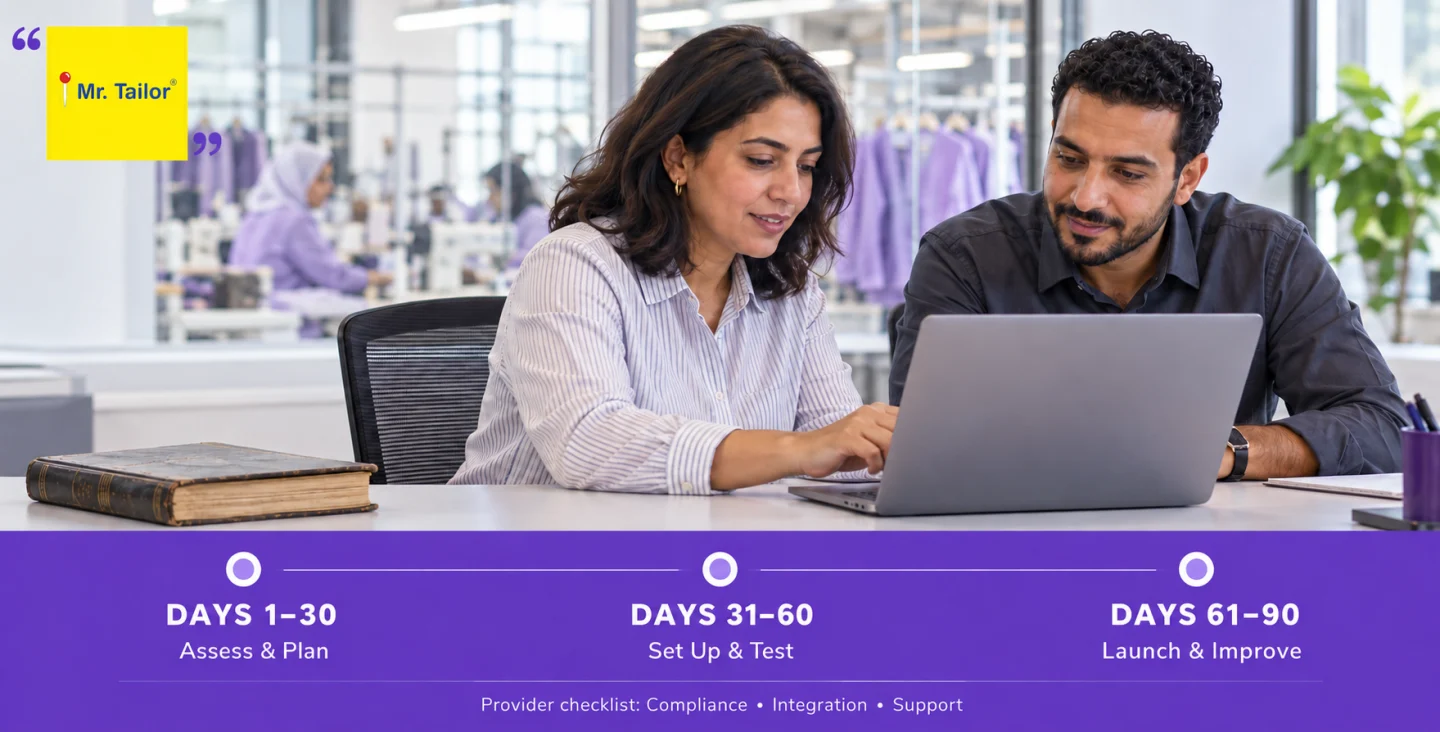
In a mid-sized Egyptian manufacturer with 300 employees, payroll takes 18 hours of calculations each month across HR and finance, and about 1.8% of payslips need a correction. After automating, a cycle takes only two to three hours to finalize, and corrections fall to 0.4%. None of this happens overnight. The change follows a 90-day roadmap. (This is an illustrative scenario with target outcomes, not a client case or unconditional guarantee.)
Manual payroll does not scale, because complexity grows faster than headcount. More sites, shifts, allowances, and statutory rules multiply the places where an error can occur. Egypt adds its own layers, and Labor Law No. 14 of 2025 now expressly accepts bank transfer as proof of salary payment, which gives digital payroll firmer legal footing.
This guide sets out a practical framework for digital payroll transformation in Egypt: why manual payroll breaks, how to build the business case, a 90-day plan, what to demand from a payroll system, and the mistakes to avoid.
In Short
Manual payroll breaks as an enterprise grows, because every extra location, pay rule, and statutory change multiplies the chances of error. Moving to payroll automation in Egypt works best as a sequenced 90-day program: audit and baseline first, pilot with a parallel run second, full rollout third. Build the business case on your own correction counts and processing hours; choose a system that handles NOSI, tax, and the annual 3% raise automatically; and give the initiative an executive sponsor.
Why Manual Payroll Breaks as You Scale
Payroll looks like a linear task: collect input, calculate, then pay. In practice, each extra employee adds far more than one line to the payroll. They bring attendance data, allowances, overtime, advances, approvals, and another place where a number can be entered twice. Add a second site, shift pattern, or legal entity, and those interactions multiply. By a few hundred employees, the payroll close depends on a handful of people who hold the logic in spreadsheets and in their heads. Our guide to the real cost of manual payroll at 500+ employees covers where this becomes unsustainable.
What the research says about errors and their cost
- An EY survey of 508 payroll professionals found that one in five payrolls in the US contains errors, the average organization makes 15 corrections per pay period, and each correction costs about $291 (EY survey, via Business Wire).
- The same EY research found that a 1,000-employee organization spends around 29 workweeks a year fixing the most common errors, and that time-and-attendance and expense errors are the most frequent.
Two caveats apply. The sample is American, and the study was commissioned by a payroll software vendor (Paycom). Treat the figures as a direction of travel, not a forecast for your company.
The Egypt-specific pain
- Changing social insurance caps. Contributions are 18.75% for the employer and 11% for the employee on an insurable wage between EGP 2,700 and EGP 16,700 from 1 January 2026. The limits rise on a schedule of roughly 15% a year through 2027. If even one entity or spreadsheet still uses last year’s cap, contributions fall short for every high earner it covers. Our guide to clean NOSI statements shows how these gaps surface in audits.
- Multi-tier income tax. Salary tax is calculated on progressive brackets, so the gross-to-net result shifts with every raise, bonus, or allowance. The Tax Authority also expects quarterly declarations and an annual reconciliation (Andersen Egypt).
- The mandatory annual raise. Private-sector employees are due at least 3% of their insured wage each year, with a floor of EGP 250 a month (Al-Ahram). It falls on each employee’s own anniversary, so a 500-person company can have up to 500 different dates to track.
Labor Law No. 14 of 2025 raises the stakes further. Employers must keep an updated statement of employee data with the Ministry of Manpower (refreshed every January), and employee files may be kept electronically for five years after employment ends. Records that live in personal spreadsheets are hard to produce, hard to reconcile, and hard to hand over when the person who built them leaves.
Maria William, Head of HR at Mr. Tailor, summed up the tipping point: “I felt it wasn’t right to keep working manually while the company kept growing in size.”
The ROI Case for Automation
For a CFO, automation is an operating-cost project with measurable payback. The benefits come from three places: fewer corrections, less processing time, and avoided compliance exposure.
Direct cost recovery
Start with corrections. The table shows the annual cost for a 100-employee company paid monthly, at two assumed costs per correction. The higher figure is EY’s $291 converted at about EGP 53 per US dollar, the mid-October 2026 market rate, or roughly EGP 15,400. The lower figure, EGP 3,000, is an illustrative local assumption.
| Corrections per monthly run | Annual cost at EGP 3,000 each | Annual cost at EGP 15,400 each |
| 2 | EGP 72,000 | EGP 369,600 |
| 5 | EGP 180,000 | EGP 924,000 |
| 10 | EGP 360,000 | EGP 1,848,000 |
Treat the EGP 15,400 column as a ceiling, because it is a US cost converted at today’s rate and Egyptian staff time costs less. Replace both figures with your own: count last year’s corrections and price the hours, re-issues, and overpayments.
Then add time. Scaled down from the EY benchmark, a 100-employee company would spend roughly 2.9 work weeks a year, about 116 hours, fixing the most common errors alone, before any calculation or reconciliation work. Finally, add avoided exposure. Applying last year’s social insurance cap to 100 employees earning above the new limit for six months costs about EGP 392,700 in unpaid contributions (29.75% × EGP 2,200 gap = EGP 654.50 per employee per month). Cash payroll above Law No. 18 of 2019 thresholds can draw a fine of 2% to 10% of the cash paid.
Be equally honest about the cost side. A realistic budget covers the license or per-employee fee, setup and data migration, integration with attendance or accounting systems, training time for HR, managers and employees, and the extra hours of the parallel run. Include them all, so the payback figure you show the board is one you can defend.
Hidden ROI
Errors also cost trust. A Workforce Institute at Kronos survey found that 49% of American workers would start looking for a new job after just two paycheck errors (HR Dive). It is a US survey from 2017, but the lesson is universal: people notice when their pay is wrong.
Payback
Payback in months equals the one-time implementation cost divided by the monthly benefit (correction cost avoided, plus hours saved at their loaded cost, plus penalties avoided). Measure it against the baseline you capture in Month 1 of the roadmap below.
The 90-Day Transformation Roadmap
The roadmap works because it sequences change: audit first, pilot second, scale third. Before Day 1, name the people involved: an executive sponsor (the CFO or COO), a project lead from payroll, an IT owner for integrations with attendance and accounting, and an HR owner for employee communication. Each phase below ends with a clear deliverable, so progress is visible to the board and not just to the project team.
Month 1: Audit and baseline
Weeks 1–2: Current-state assessment
- Document the existing process end to end: time tracking, calculations, approvals, and disbursement.
- Identify bottlenecks and the touchpoints where errors enter.
- Calculate the current cost per payroll run, in hours and EGP.
- Clean your employee master data now. Names must match the National ID exactly, because mismatches stop account creation and verification later (see our KYC guide for payroll accounts).
Weeks 3–4: KPI baseline
- Processing time per cycle.
- Error rate: corrections divided by payslips issued. Agree on a target with your finance team before the pilot.
- Payroll processing cost per employee per cycle.
Deliverable: a one-page baseline that the CFO, HR, and IT all sign off. Without it, nobody can prove the project worked.
Month 2: Pilot and quick wins
Weeks 5–6: System selection and trial
- Evaluate shortlisted systems against Egyptian requirements: NOSI, tax, and Central Bank supervision.
- Run a parallel payroll, manual and automated, and verify that the calculations match line by line.
- Agree acceptance criteria before you start: for example, every variance explained and resolved, and no unexplained differences in NOSI or tax figures, before you approve cutover.
Weeks 7–8: Training rounds
- HR and payroll staff on system administration.
- Department managers on approvals.
- Employees on the self-service portal.
Mr. Tailor followed this pattern. According to Maria William, Head of HR, the company had a customized HR system built, ran a trial phase first, and held several tutorial rounds for employees before moving fully from the manual process to the new automated one.
Month 3: Full rollout
Weeks 9–10: Cutover
- Switch primary processing to the automated system.
- Keep a manual backup for one cycle.
- Resolve exceptions as they surface and log each one.
- Confirm that the first bank file, NOSI statement, and tax figures reconcile to the automated register before funds are released.
Weeks 11–12: Optimization
- Compare KPIs with the Month 1 baseline.
- Document the process improvements.
- Set 12-month efficiency targets.
- Assign a named owner for the system after go-live, including who applies each January’s social insurance and annual-raise changes.
Ninety days is a realistic target for a focused rollout. A group with many sites or entities may phase it, starting with the pilot sites.
What to Look for in an Egypt-Ready Payroll System
These are the non-negotiables. Our guide to evaluating a salary payment system in Egypt expands them into a scorecard.
Compliance automation
- NOSI contribution calculation and statements. dopay, for example, calculates NOSI contributions inside payroll and tracks payments month by month (dopay NOSI guide).
- Automatic tax bracket calculation.
- Social insurance cap updates applied when NOSI announces new limits, with a changelog your team can verify each January.
- Calculation of the 3% annual raise on each employee’s anniversary.
Payment infrastructure
- Bank transfer capability. It is accepted as proof of payment under Labor Law No. 14 of 2025, and employers with more than 25 employees or monthly wages above EGP 100,000 must use non-cash methods under Law No. 18 of 2019.
- Multiple disbursement channels (bank, card, wallet) within the same payroll run, so banked and unbanked staff are paid together.
- Central Bank of Egypt supervision. dopay operates under a banking-agent license from the Central Bank, obtained through Bank ABC Egypt.
Operational features
- Time-tracking integration, which removes the reconciliation bottleneck.
- An employee self-service portal.
- Multi-branch and multi-entity support.
- An Arabic-language interface and Arabic payslips.
When you shortlist vendors, ask five questions. How quickly do you apply new NOSI limits, and who verifies the change? Can I see the audit trail for one employee’s salary history? Can I pay banked and unbanked staff in the same run? Which Central Bank license or supervision covers the payment flow? What does the first cycle look like, and who supports it?
Red flags to avoid
- A system not updated for Labor Law No. 14 of 2025.
- Social insurance caps that your team must update by hand.
- No audit trail.
Common Implementation Mistakes
Five pitfalls are behind most stalled rollouts. For a founder-level view of the basics, see our guide to five payroll mistakes first-time founders make.
1. Skipping the parallel run
A system can be configured correctly and still be wrong on real data. A full cycle in parallel exposes rounding, allowance, and cap errors while the old process is still your safety net.
Risk: Undetected calculation errors reach the first live cycle. Fix: Run manual and automated payroll side by side for at least one full cycle.
2. Underinvesting in training
A single session before go-live is not enough. People revert to what they know when the first exception appears, so schedule refreshers after the first live cycle too.
Risk: The HR team reverts to manual workarounds. Fix: Prepare for multiple training rounds, not just an initial session.
3. Ignoring time-tracking integration
If attendance arrives late or as a spreadsheet, payroll inherits the errors and the team rebuilds the manual reconciliation the project was meant to remove.
Risk: Late or inaccurate attendance data cancels out the gains from automating payroll. Fix: Pair attendance automation with payroll from day one.
4. Choosing on price alone
The cheapest license can cost the most if it needs manual cap updates, lacks a Central Bank-supervised payment flow, or cannot produce an audit trail.
Risk: Compliance gaps, manual workarounds, and hidden costs. Fix: Compare total cost of ownership, including compliance risk.
5. No executive sponsor
Rollouts touch HR, finance, IT, and operations. Without a sponsor who can resolve disputes, the first disagreement over data ownership can stall everything.
Risk: The transformation stalls at the first resistance. Fix: Give ownership to the CFO or COO.
Conclusion
Digital payroll transformation is not a technology project. It is an operational efficiency initiative with compliance benefits. The 90-day roadmap works because it sequences change: audit first, pilot second, scale third. For Egyptian enterprises navigating Labor Law No. 14 of 2025, the Central Bank’s non-cash payment rules, and annually changing social insurance limits, automation is no longer a nice-to-have; it is a compliance necessity.

 Blog