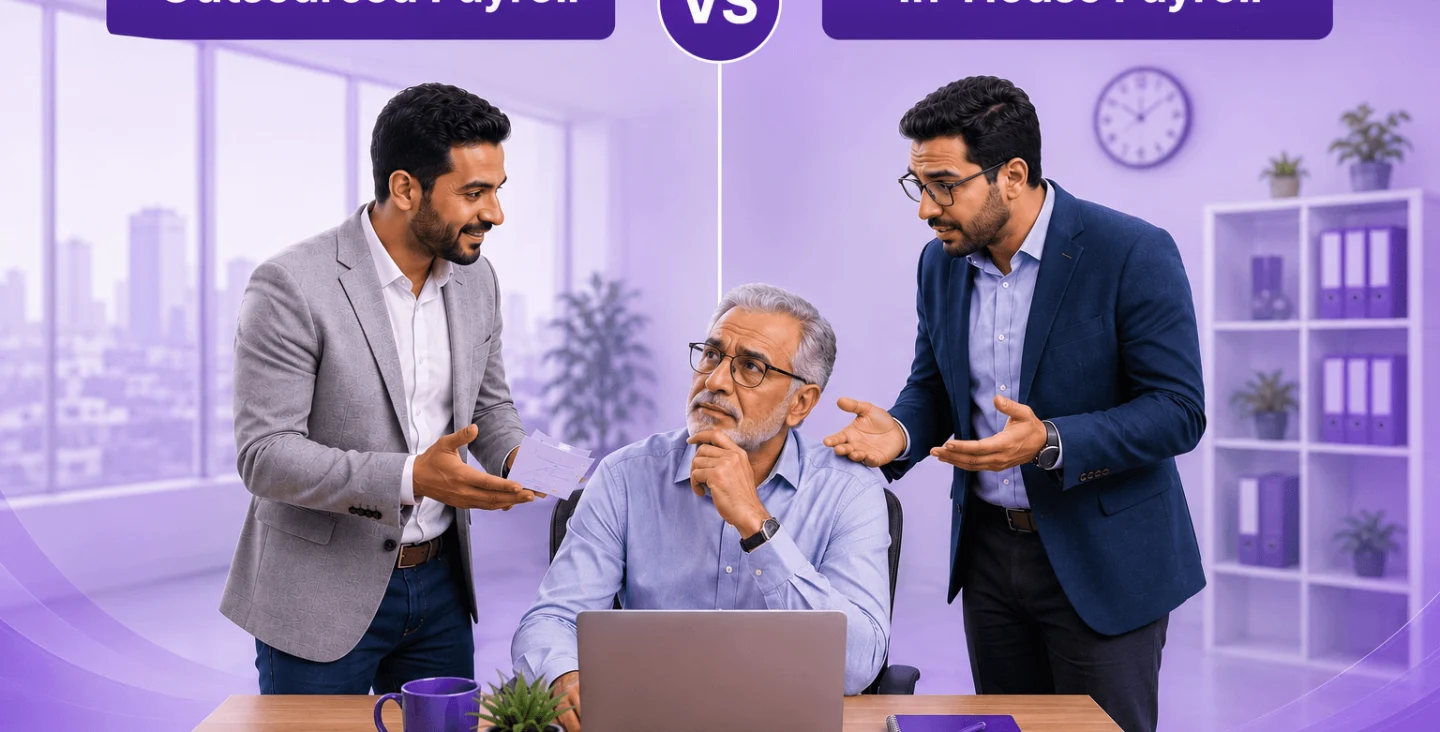
Outsourcing payroll in Egypt pays off when three things show up together: a headcount large enough to consume finance time every month, a compliance picture that’s getting harder to keep clean by hand, and an error-cost exposure that one missed filing would prove painful. When any of those is missing, in-house payroll can still be the right call.
We’ve sat with Egyptian CFOs and SME owners through this decision dozens of times, and the answer is rarely “always outsource.” It’s a framework. Below are the break-even signals, the cases where an in-house model still wins, and a short self-scoring section you can go over in five minutes.
IN SHORT
The outsourcing-vs-in-house decision in Egypt centers on headcount, compliance complexity, and error-cost exposure, not on company size alone. SMEs with under 20 employees with simple, flat salaries can run payroll in-house cleanly. SMEs with over 40 employees and shift work, variable pay, or frontline cash distribution almost always benefit from a payroll platform. Between those numbers, the answer depends on finance bandwidth and audit risk appetite.
THE FRAME
Why is the outsourcing question harder than it sounds in Egypt?
|
Payroll outsourcing in Egypt is rarely a simple, straightforward cost-vs-cost calculation. Three things complicate the math: a workforce that mixes banked and cash-paid employees, social-insurance rules that have been moving year on year, and finance teams already running close to capacity. Each factor shifts the break-even point. |
Most CFOs compare one number: the outsourced fee versus what they’re paying in-house. That gap is usually small, so the decision feels like a wash. But that’s the wrong comparison. The real cost isn’t in what you pay when things go right — it’s what you pay when things go wrong: a missed filing, a penalty, one person out sick during a critical run. Rare, but expensive when they hit.
The World Bank’s Global Findex puts formal bank account ownership among Egyptian adults at around 27%. Central Bank of Egypt figures show that number climbing closer to 70% once mobile wallets are included. For an employer, this means part of the team can receive a bank transfer, and part still needs to be paid in cash. Any real cost comparison has to account for both.
There’s also a compliance layer. The Tax Authority, the social-insurance regulator, and the labor inspectorate each want payroll evidence, and each asks for it a bit differently. In-house teams can produce it — but speed matters. ILO data shows informal employment in Egypt has long stayed above 60% of non-agricultural jobs, meaning many SMEs are formalizing payroll for the first time as they grow.
Across the businesses we’ve worked with at dopay, the outsourcing decision is rarely about cost alone. It’s about who carries the risk, and where finance wants to spend its time. So take a look below — which side of the line is your operation on?
BREAK-EVEN
Where does the break-even point actually sit?
| Outsourced payroll in Egypt usually breaks even somewhere between 20 and 40 employees — but headcount is only one factor. The other two: compliance complexity (shifts, variable pay, multiple sites) and error-cost exposure (what one missed filing would cost in fines or disputes). |
Under 20 employees with flat salaries, a good accountant with a spreadsheet and a couple of logins can usually handle the monthly cycle in a few hours. An outsourced platform rarely beats that on price alone — at this size, the case for it is convenience and continuity, not cost.
Between 20 and 40 employees, it gets interesting. The accountant’s hours climb, small errors start showing up in social-insurance reconciliation, and salary advances become routine. The cost of those hours plus the occasional error often crosses the platform fee. This is where most Egyptian SMEs start asking the question seriously
Above 40 employees — especially with shift work, variable pay, or multiple sites — the case usually settles. Per the Central Bank of Egypt’s 2024 Financial Inclusion Indicators, mobile-wallet growth has made digital disbursement practical at this scale.² Here’s a rough guide to the signals:
| SIGNAL | LEAN IN-HOUSE | LEAN OUTSOURCED |
| Headcount | Under 20, stable | 40+, growing |
| Pay structure | Flat monthly salaries | Shifts, overtime, tips, bonuses |
| Sites and locations | Single location | Multi-site or distributed |
| Workforce composition | Mostly banked employees | Mixed banked and cash-paid |
| Finance bandwidth | Spare capacity in-house | Close already stretched |
| Audit risk appetite | High tolerance for slow evidence | Needs fast, line-by-line evidence |
| Cost-of-error exposure | One missed cycle is recoverable | One missed cycle is expensive |
Read the table as a tilt, not a verdict. Most Egyptian SMEs show three or four signals on one side and two or three on the other. The decision comes down to where the heaviest signals land, and especially in how you weigh audit risk against in-house bandwidth.
IN-HOUSE
When does keeping payroll in-house still make sense?
| In-house payroll still wins for very small headcounts with flat salaries, single-site operations with a strong accountant already on staff, and organizations where finance has explicit spare capacity. It also wins for businesses where payroll is genuinely simple and where outsourcing would feel like buying a tool to solve a problem you don’t have. |
Keeping payroll in-house is not a matter of nostalgia; for a lot of SMEs, the in-house cycle just works. A 12-person firm paying flat bank-transfer salaries, with no shifts or tips, rarely needs a platform. The fee would be real cost added to a process that already runs fine.
A second case: some CFOs want payroll close by design — it’s how they stay in touch with headcount, bonuses, and exit costs in real time rather than through a dashboard. Fair enough, but the time cost should be priced honestly.
A third case: businesses with data sensitive enough that they want payroll processed on their own servers, under their own contracts. This is rare among Egyptian SMEs, but it shows up in family offices and some legal or healthcare settings. In these scenarios, deciding on whether to resort to outsourcing becomes a longer conversation.
NOTES FROM THE DOPAY TEAM
We don’t pitch dopay for Business to every Egyptian SME we meet. When a 10-person consultancy with flat salaries asks us about the platform, the honest answer is usually that their current setup is fine for now, and that the conversation is worth having again when headcount crosses 25 or when they open a second office. Selling the wrong fit is what destroys customer success conversations a year later.
OUTSOURCING WINS
When does outsourcing clearly win?
| Outsourcing clearly wins when the monthly cycle is consuming finance time the company would rather spend on analysis, when the workforce mixes banked and cash-paid employees, when shift-based or variable pay makes errors common, and when audit or social-insurance evidence has to be produced fast. In those cases, the platform fee is usually the smallest line in the comparison. |
The clearest case: frontline workers paid in cash. Cash payroll has a hidden tax — someone draws it, counts it, hands out envelopes, files signatures. That’s hours the floor needed elsewhere. Moving to a digital platform removes the cash step, and unbanked workers get an account and card from day one.
A second case: shift-based teams. CAPMAS Labour Force Survey data shows a meaningful share of Egypt’s non-agricultural workforce on rotating schedules, where overtime and shift pay hit every payslip.⁴ Manual reconciliation of those variables is where errors creep in — and one error a quarter is enough to tip the math.
A third case: companies facing frequent audit or social-insurance checks. In our conversations at dopay, the moment a CFO relaxes is when their accountant pulls up a payroll register with one timestamped row per employee, reconcilable against the bank statement line by line. It’s not about new rules — it’s about how fast the evidence shows up. (Full terms for business use are on the dopay business terms page.)
A fourth, often-missed case: SMEs that want finance out of the payroll-questions business. When an HR lead or employee can pull their own payslip from an app, finance gets its time back. Rarely the deciding factor alone, but it often closes the deal.
SELF-SCORE
A short self-scoring exercise: which side are you on?
| Answer the seven questions below honestly. Each “yes” pushes you toward outsourcing; each “no” pushes you toward keeping payroll in-house. Four or more “yes” answers usually means the platform conversation is worth having. Three or fewer means the in-house cycle is probably still the right call for now. |
This is not a scoring tool that hands you a verdict. It is a structured way to reveal the inputs you might be weighing implicitly. Run through it with whoever owns the final call.
| # | QUESTION | IF YES |
| 1 | Is your headcount above 30 employees today, or growing toward 40 within the year? | Outsource |
| 2 | Do you have shift-based, variable, or tip-based pay structures that change month to month? | Outsource |
| 3 | Do you pay any portion of your team in cash today, or onboard new hires who don’t yet have a bank account? | Outsource |
| 4 | Has your finance team flagged the monthly payroll close as one of their longest tasks? | Outsource |
| 5 | Have you had a social-insurance or labor-inspector evidence request in the past 12 months that took more than a day to gather? | Outsource |
| 6 | Do you operate across more than one site, branch, or outlet? | Outsource |
| 7 | Would one missed or late payroll cycle cost you more than the annual platform fee in disputes, fines, or lost operating hours? | Outsource |
If you answered yes to four or more questions, the outsourcing conversation is worth a serious 30 minutes. If you answered yes to three or fewer, the in-house cycle probably still fits, and the conversation is worth revisiting next year or at the next growth step. Either answer is a defensible one.
 Guide
Guide