Guide
Guide


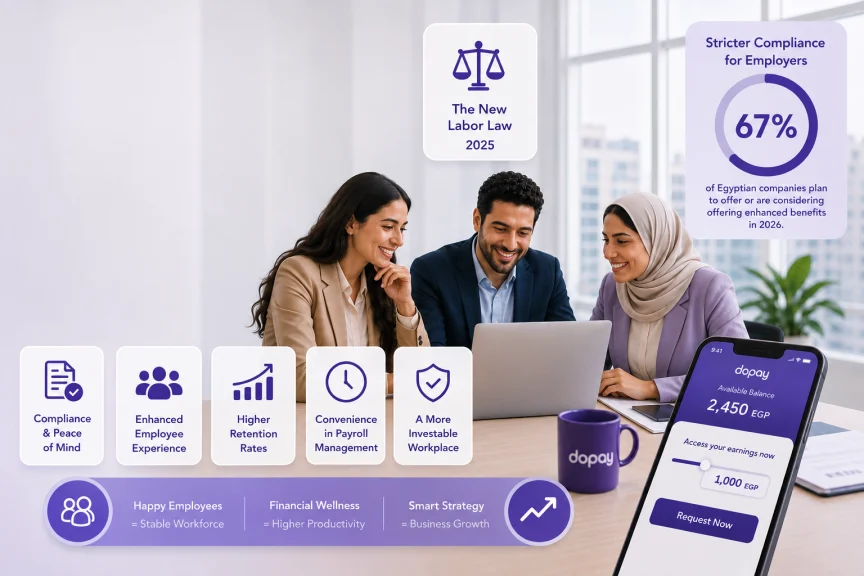
EarlyPay lets your team access part of the wages they’ve already earned, mid-cycle, through the dopay app. The amount is auto-deducted at the next payday, with no loan, no interest, and no new work for your HR team.
If you’re already running payroll through dopay, switching it on is a really simple configuration change. Across the businesses that have turned it on, the operational picture is usually calmer than most HR managers expect, and the cycle doesn’t change shape.
In Short
EarlyPay is dopay’s earned wage access product for existing dopay customers. Employees request a portion of already-earned wages from the dopay app, and the amount is netted against the next payroll run. For HR, almost nothing changes in the monthly cycle. For finance, reconciliation looks the same with one new line. For workers, the awkward salary-advance conversation goes away.
What does EarlyPay actually do on payday?
Earned wage access is one of the more carefully defined categories in payroll. The International Labour Organization, in its 2023 work on wage payment digitization, frames EWA as a timing tool rather than a credit product: the worker is paid for time already worked, just earlier in the cycle.
The Central Bank of Egypt has issued guidance during the past couple of years that supports the same definition for the Egyptian market, drawing a clear line between EWA and consumer lending.
In practice, here’s the flow of using EarlyPay from dopay.
- The worker opens the dopay app on day 8- 25 of the month and sees a balance of wages earned to that date.
- Requests a portion up to the configured cap (set by the employer).
- The amount lands on the dopay card in less than an hour.
- The salary transfer at payday is reduced by that amount, and that’s all!
The accounting picture is conservative on purpose. Because the worker can only ever access what they have already earned, the maximum exposure at any moment is bounded by hours worked to date, multiplied by the agreed wage rate, multiplied by the access cap.
Then, by the end of the month, your business gets a detailed invoice including how many employees used the service and accordingly the fees. Bear in mind that the fees of EarlyPay are capped at 70 EGP per transaction.
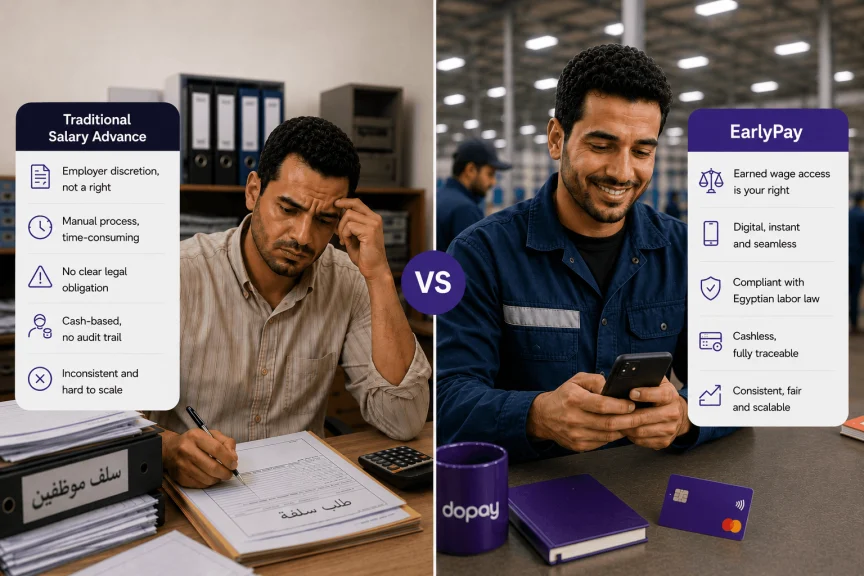
Across the businesses that have partnered with dopay, the most common misconception we see at the start of an EarlyPay conversation is that it works like a salary advance.
It doesn’t. A salary advance creates a receivable the company has to chase, often manually, often with awkward conversations between HR and the worker. EarlyPay is reconciled within the same payroll run the worker is already part of, with nothing for HR to chase.
What changes for HR when you switch EarlyPay on?
HR managers in Egypt typically meet earned wage access with two questions. The first is whether it adds operational load to a team already running the monthly cycle, payroll changes, and onboarding for new hires. The second is whether it replaces something that already happens informally, and what that replacement actually looks like.
On the first question, the load really is close to zero. Approval logic sits in the platform: the cap, the eligibility rules, and the timing windows are configured once and apply across all access requests. Employees interact with the dopay app, not with HR. There’s no advance request form, no signature, no spreadsheet to update.
However, it is worth noting that if you want to approve/decline each EarlyPay request, you can easily do that through the dopay for Business platforms.
On the second question, the replacement is usually a mix of informal salary advances and, in some cases, the kind of short-term informal lending that workers fall back on between paydays.
Academic work on EWA adoption across emerging markets has consistently linked formal earned wage access with reductions in informal high-cost borrowing.
What we keep seeing across the HR teams that have switched it on is the same pattern: the awkward Tuesday-morning advance conversation simply doesn’t happen anymore.
What changes for finance?
For finance teams, the reconciliation pattern is the most useful place to look. A monthly payroll run on dopay produces one register per cycle, with one row per employee and a set of standard columns: gross wage, social insurance, tax, deductions, net. When EarlyPay is in scope, one extra column appears: the cumulative EarlyPay amount disbursed during the cycle. The net salary transferred to the worker’s dopay account on payday is the standard net minus that column.
Cash flow into payroll doesn’t change.
Your company still funds the full monthly gross payroll on the agreed date. The earlier disbursements during the cycle are funded by dopay, and reconciled within the same payroll. From the finance team’s view, the bank statement on payday matches the payroll register line-by-line, exactly as it did before.
| What Changes | Before EarlyPay | After EarlyPay |
| HR involvement | Per request Informal approval, ad hoc |
None, handled in the dopay app |
| Reconciliation | Manual tracking of advances |
One new column on the register |
| Social insurance and tax base | Gross monthly wage | Gross monthly wage, unchanged |
| Employer balance-sheet impact |
Receivables from advances |
Zero, dopay funds the gap |
| Worker debt created | Possible via informal lending |
None, only earned wages accessed |
For compliance teams, the relevant point is that gross wage, social insurance contributions, and tax calculations all remain anchored to the full monthly wage. Egypt’s Labor Law treatment of wage deductions is unchanged, because EarlyPay isn’t, under the law, a deduction. It’s a timing change within the net salary path.
Should you switch it on?
You might be wondering about the importance of EarlyPay and if it’s worth it. Since numbers speak louder than words, here are some facts about companies that use EarlyPay with dopay:
- 39% drop in financial stress, leading to higher productivity.
- 31% increase in employee satisfaction.
- Up to 74% reduction in absence.
- 20% reduction in mental and physical health complaints.
- 300,000 EGP potential savings in lost productivity per 1,000 employees.
Some companies even reported a 35% increase in retention!
What adoption patterns do we see across dopay customers?
Adoption patterns are one of the parts of EarlyPay HR managers ask about most, because the question behind the question is usually: will my whole workforce drain it every month?
The honest answer is no. Across the businesses that have partnered with dopay, usage settles at a minority share of eligible employees, and most users access it once or twice per cycle rather than continuously.
The usage profile is also fairly concentrated. Frontline workers in shift-based roles, including hospitality, retail floor staff, and manufacturing operators, account for the bulk of access events. Office-based and salaried mid-management roles use it less, often not at all.
FROM THE FIELD, WHAT WE SEE ON THE GROUND
The first conversation we have with an HR manager about EarlyPay is usually shorter than they expect. Most of the worry is about whether it adds a queue at the HR desk, and once we walk through the request flow, that worry leaves the room. By month two, the same HR manager is usually asking whether we can extend access to a second outlet or to the office team, not whether we can scale it back.
The retention signal is the harder one to read in a single cycle, but HR leaders running EarlyPay over several months often report a steadier frontline workforce. The pattern is most visible in shift-based sectors like hospitality, retail, and manufacturing, which suggests the wage-access feature itself plays a role, not just a sector quirk.
For HR managers thinking about extending EarlyPay across the rest of the workforce, the pattern carries over to hospitality teams and retail and wholesale groups in almost the same shape. The shift-based, frontline cohort is where the benefit lands hardest, because the gap between when work happens and when payday lands is exactly where the informal advance conversation used to live.
How do you turn EarlyPay on for your team?
EarlyPay doesn’t require a new system, a new integration, or a new vendor relationship. If you’re already running payroll on dopay, it’s a switch you flip inside a setup you already trust.

 Blog
Blog