Back to hub

Salary advances under Egypt’s labor law: what employers can and can’t do

EarlyPay Financial Wellness Retention & Engagement Systems & Compliance July 27, 2026
Salary advance Egypt labor law

Salary advances under Egypt’s labor law are allowed, but only within a clear set of limits: a written agreement, a monthly deduction kept within the statutory ceiling, and a payroll record that an inspector can read. Everything outside that frame poses real risks.

We’ve investigated where mid-market employers in Egypt most often run into trouble on advances. The patterns are consistent enough to write down, and most of them are fixable with one short policy and one clean payroll line.

IN SHORT

Egypt’s labor framework, anchored by Labor Law 14 of 2025, permits salary advances when they are documented, capped per month, and reconciled against payroll. Off-book “patron-style” advances from petty cash now carry real audit and social-insurance risk. Earned wage access is treated similarly in terms of discipline but differs on credit. A clean written policy and a payroll-card-based flow remove most of the risks.

THE FRAMEWORK

What does Egypt’s labor law permit on salary advances?

Egyptian labor law permits a salary advance when it meets the following three requirements: a written agreement signed by the employee, a monthly deduction kept within the statutory cap on payroll withholdings, and a reconcilable payroll record. The framework is supportive of advances, but it is strict about how they are recorded.

A salary advance under Egyptian labor law is a documented arrangement, not an informal favor. The framework is anchored by Egypt’s Labor Law 14 of 2025, published in the Official Gazette on 3 May 2025 and enforced from 1 September 2025, which replaced the previous law and codified provisions that had been treated unevenly across employers. The key aspects from the older framework are carried over to the new law: advances are permitted, repayment runs by deduction from future salary, and total monthly deductions cannot exceed the statutory ceiling.

The current statutory cap on monthly wage deductions, which has been adjusted periodically and which your counsel should confirm for each new program, should amount to a small fraction of the employee’s net monthly pay. The ceiling exists to prevent the employee’s take-home from being eroded by stacked deductions, including loan repayments, social-insurance contributions, and any court-ordered withholdings. The International Labour Organization’s country reporting on Egypt notes that deduction protections of this kind are a long-standing feature of Egyptian labor regulation.

In practice, what an HR manager needs to see before issuing an advance is straightforward: (a) the employee’s written request and consent, (b) a repayment schedule that fits within the ceiling, and (c) a line in the payroll register that records the advance as a receivable and the monthly deduction as a recurring entry. None of these are new requirements under Law 14. What’s changed is the scrutiny: digital payroll records make non-compliance much easier to spot during an audit or labor inspection.

Across the businesses that have partnered with dopay, the request for a cleaner advance policy is often what brings finance and HR to the same table for the first time. We’re using dopay for Business as the reference point here because the payroll register, the deduction line, and the disbursement record are all placed in one system. But the underlying legal discipline applies no matter which platform you end up choosing.

This article is informational and does not constitute legal advice. Confirm the current statutory figures and the application to your specific situation with your counsel.

INFORMAL ADVANCES

Where do informal, off-book advances run into trouble?

Informal advances from petty cash, slipped to an employee without a written agreement and without a payroll entry, used to be common practice in Egyptian SMEs. Under the current framework, this kind of advance creates three exposures at once: a tax exposure, a social-insurance exposure, and a labor-inspection exposure.

The “patron-style” advance has its own logic. An employee asks for help between paydays. The owner or the GM hands over cash from the petty-cash drawer. A note is scribbled in a notebook, or nothing is recorded at all. The amount is taken back from next month’s salary envelope, give or take. This worked for decades. It doesn’t work the same way today.

The shift stems from three factors. Tax authorities and social-insurance bodies increasingly cross-check declared wages against bank-disbursement records. The Central Bank of Egypt’s financial-inclusion push, which lifted any-formal-account ownership toward 70% in 2024, has pulled more of the workforce into the visible payroll system. Labor Law 14 of 2025 raised the documentation expectations on the employer’s side. Together, those three factors mean that an undocumented cash advance now reads as an undocumented cash payment, which is a different problem.

The second risk is rollover. Informal advances often roll: the employee can’t repay the full amount in one cycle, the balance carries, another advance comes in, and the running balance is not recorded anywhere. When the employee leaves, the employer has no enforceable claim on the balance, and when an inspector asks for the trail, there isn’t one. This is the pattern Egyptian labor counsel most often flags as “the avoidable dispute”.

From on-ground experience across dopay’s customer base, the move away from petty-cash advances usually happens for an operational reason first, and the compliance benefit follows. The owner gets tired of carrying the personal liability. The accountant gets tired of the reconciliation gap. The HR lead gets tired of the awkward conversations. The legal exposure had always been there, but it’s the daily hassle that finally moves the policy.

EWA VERSUS ADVANCE

How does earned wage access differ from a traditional salary advance?

Earned wage access (EWA) lets an employee access pay they have already earned for hours already worked. A traditional salary advance is a forward draw against work not yet performed. The Egyptian labor framework treats both similarly in terms of documentation and deduction discipline, but it treats them differently in terms of credit.

The legal distinction matters. A salary advance is, in substance, a short-term loan from employer to employee, repayable by deduction from future wages. Even when no interest is charged, the law treats it as a forward draw. That’s why the deduction-cap rules apply, why a written agreement is expected, and why a balance can carry across pay cycles.

EWA is different. The employee accesses a portion of money he/she already worked for, before the standard payday. There’s no loan, no interest, no future obligation: the access amount is netted out of the same period’s payroll run. The Egyptian framework, ILO’s general guidance on wage protection, and the academic literature on EWA converge on the same point: EWA is wage access, not credit. That distinction removes the question of financing cost and removes the rollover risk that creates most of the disputes on traditional advances.

The shared discipline still applies. Both flows need a written framework, a documented record per employee, and accurate reconciliation against the payroll register. Where they diverge is the carry: an advance can carry, an EWA draw cannot. That single property is what makes EWA easier to keep within the statutory cap and easier to defend in an audit.

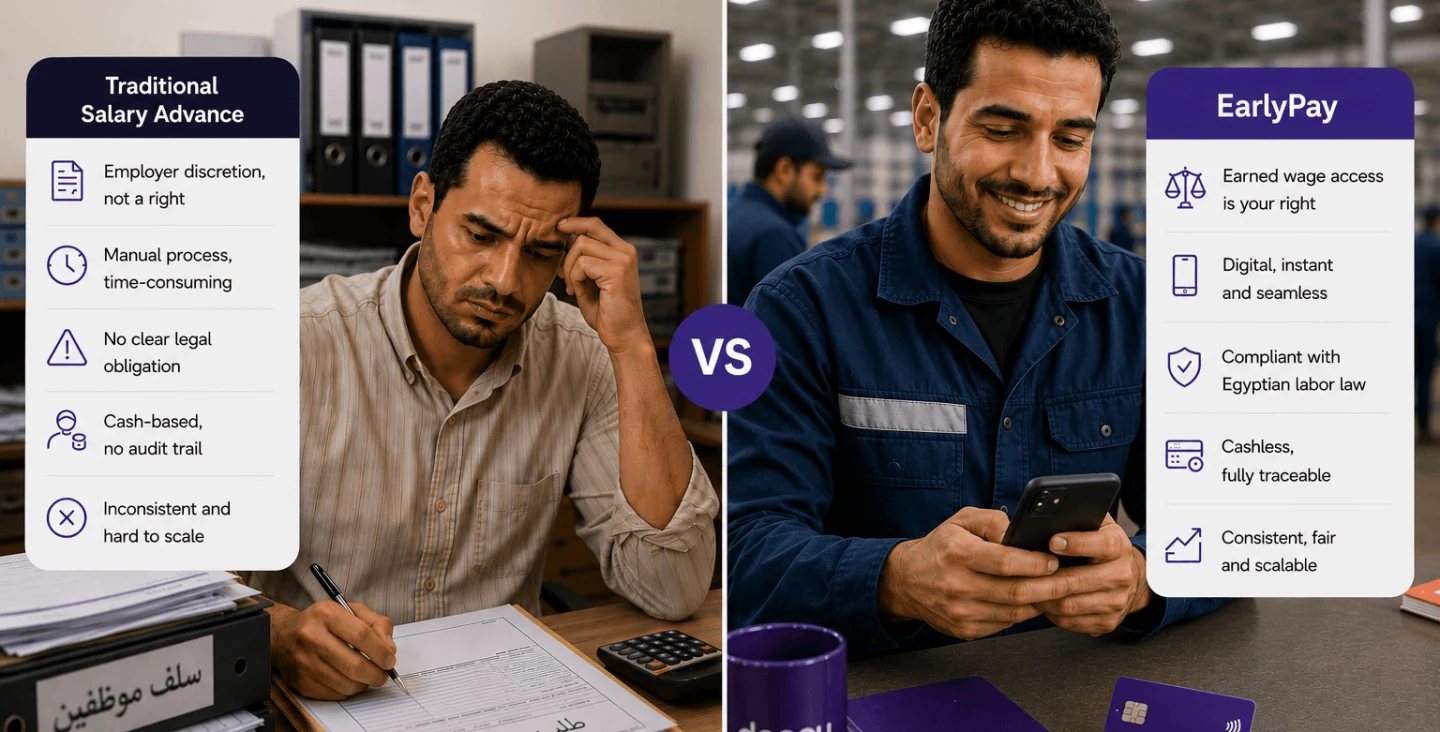
Take a look at the comparison below and you be the judge: which column fits your current advance practice?

Dimension Traditional salary advance Earned wage access
Legal nature Forward draw against future pay Access to pay already earned
Written agreement required Yes, per advance Framework agreement once, then per-draw record
Carries across pay cycles Yes, often the source of disputes No, settled within the same cycle
Statutory deduction cap applies Yes, on the monthly deduction Yes, on the same payroll-cycle netting
Interest or financing cost Cannot be charged in practice Not applicable, no credit extended
Recovery if employee leaves mid-balance Settled from end-of-service, within cap No outstanding balance to recover
Audit-trail integration Manual record in payroll register Automatic line in the digital register

Move advances onto a clean payroll flow.

See how dopay for Business handles documented advances and earned wage access within the same monthly cycle.

WRITING A POLICY

How do you write a clean salary-advance policy for an Egyptian SME or mid-market employer?

A clean advance policy fits on two pages. It defines eligibility, ceilings, frequency, repayment terms, documentation, and the exit case. The policy remains with HR, the template advance agreement remains with payroll, and both reconcile to the same register every month.

The policy is where the legal framework becomes operational. A well-written internal policy answers the questions an HR manager will get throughout the year: who’s eligible, how much can be requested, how often, on what terms, what happens at exit, and where will everything be recorded and kept. The labor framework provides the outer limits, while the policy provides the day-to-day discipline.

Six elements belong in the policy:

  • Eligibility: minimum tenure (commonly three to six months), employment status (typically permanent staff), and any role-based exclusions.
  • Ceilings: a maximum advance amount as a fraction of monthly base pay, and a maximum number of open advances per employee at any time.
  • Repayment terms: a minimum and maximum number of cycles for repayment, with the monthly deduction kept within the statutory cap.
  • Documentation: the template advance agreement, signed before disbursement, with the schedule and the employee’s acknowledgment.
  • Exit case: the calculation that applies when an employee leaves mid-balance, including how the balance is netted from end-of-service.
  • Record-keeping: where each advance is recorded, who approves it, and the reconciliation cadence against the payroll register.

One pattern worth highlighting: the policy should explicitly forbid off-book advances. Without that clear statement, owners and GMs continue to issue petty-cash advances “as exceptions” because the policy never said they couldn’t. The statement is short and unambiguous: any advance outside the documented process isn’t an advance, and it doesn’t bind the employer or the employee in the way they expect.

NOTES FROM THE DOPAY TEAM

The cleanest policies we see in the field run on two simple rules: one open advance per employee at a time, and repayment must close within three monthly cycles. Both are stricter than the statute requires. Both prevent the rollover pattern that creates 80% of the disputes our customer success teams hear about, and both make the audit trail dramatically easier to produce on demand.

The policy is also where an employer chooses whether to keep traditional advances as an option at all. Many mid-market employers using dopay for Business have moved entirely to earned wage access for the small-amount, between-payday liquidity case, and they chose to reserve formal advances for larger, less-frequent needs. The split keeps the audit trail clean and matches each tool to the case it fits.

EARLYPAY

How does dopay’s EarlyPay fit inside this framework?

EarlyPay is dopay’s earned wage access (EWA) product. Employees of companies running payroll through dopay for Business can access part of the pay they have already earned, with the amount taken from the same payroll cycle. The flow is documented, capped, and reconcilable, which is what the Egyptian labor framework asks for.

EWA in Egypt is still a fairly new category for employers used to the traditional advance. The shape of the product matters: it must remove the hassle of the between-payday liquidity case without recreating the rollover risk that makes informal advances dangerous. In practice, the legal framework rewards exactly that shape.

EarlyPay (اقبض بدري) is structured as EWA. The employee accesses pay he/she already worked for, the amount is deducted from payday, and the employer’s payroll register carries the information automatically. The HR team isn’t in the approval loop of each request, and the finance team doesn’t need to fund the advance from working capital. The audit trail is built into the same monthly register that processes base pay, overtime, and any other variable element.

Within our customer success conversations at dopay, the moment an HR manager actually relaxes is when they realize the awkward “can I have an advance” conversation isn’t theirs to manage anymore. The employee handles the request via the app, the withdrawal is capped by what the employee has already earned, and the payroll register records it without needing HR’s approval per request. The same logic applies in manufacturing teams and retail and wholesale operations, where shift-based pay cycles create exactly the between-payday case that EarlyPay is designed for.

Our 24/7 customer care teams in Cairo handle the employee-side questions in Arabic and English, and our customer success teams walk HR and finance teams through the policy alignment before the first EarlyPay-enabled payday. The full terms covering business use are available on the dopay business terms page, and additional context on the product itself can be found on the EarlyPay product page.

You can read related pieces on payroll discipline and the new labor law in the dopay Knowledge Hub, specifically in the Payroll and Systems and the Compliance categories.

EarlyPay (اقبض بدري) is available to employees whose employer is already a dopay for Business payroll customer. It cannot be acquired by individuals or by employers standalone.

Frequently Asked Questions

Egyptian labor law has long set a ceiling on the share of monthly pay that can be withheld for repayment of a salary advance, expressed as a fraction of the employee’s net pay. The exact percentage is set by statute and adjusted periodically. As a working guideline, employers should treat the deduction as a small share of monthly pay and confirm the current statutory figure with their counsel before each new advance program.

Egyptian labor law does not set a hard frequency cap on advances, but employers carry the obligation to keep total deductions within the statutory monthly limit. In practice this means a second advance cannot start while a previous one is still being repaid above the cap. A written internal policy that limits frequency and overlapping balances is the safer path.

In practice, yes. A written, signed advance agreement is the standard the labor framework expects. The agreement records the amount, the repayment schedule, the monthly deduction amount, and the employee’s acknowledgment. An advance handed over without documentation is treated as an unrecorded payment and creates exposure on tax, social-insurance, and end-of-service calculations.

Outstanding balances on a documented advance are typically settled from the employee’s final settlement, including end-of-service entitlements, within the limits set by law. Undocumented advances are difficult to recover and may not be enforceable. Counsel should review the calculation case by case, especially where end-of-service entitlements interact with the deduction cap.

Yes. Loading an advance onto an employee’s payroll card is included within the same documented payroll flow as base pay. Each transaction carries a timestamp and a reconcilable record, which is exactly what the labor framework asks for. Petty-cash advances slipped to an employee without a receipt are not included in that flow and recreate the very risk a clean payroll system removes.

No. Earned wage access lets an employee access pay they have already earned for hours already worked. A traditional salary advance is a future-pay loan against work not yet completed. The labor framework treats them similarly in terms of documentation and deduction discipline, but earned wage access does not extend credit, which removes the question of interest or financing cost entirely.

An employer cannot deduct more than the statutory ceiling per month, cannot charge interest or a fee that turns the advance into a loan product, cannot make the advance conditional on the employee accepting unrelated terms, and cannot hand over money off the books. Off-book advances often surface during a labor or social-insurance inspection and are the most common source of avoidable disputes.

Bring salary advances onto a defensible payroll flow

We will walk through your current advance practice, align it with the labor framework, and set up the register together.