
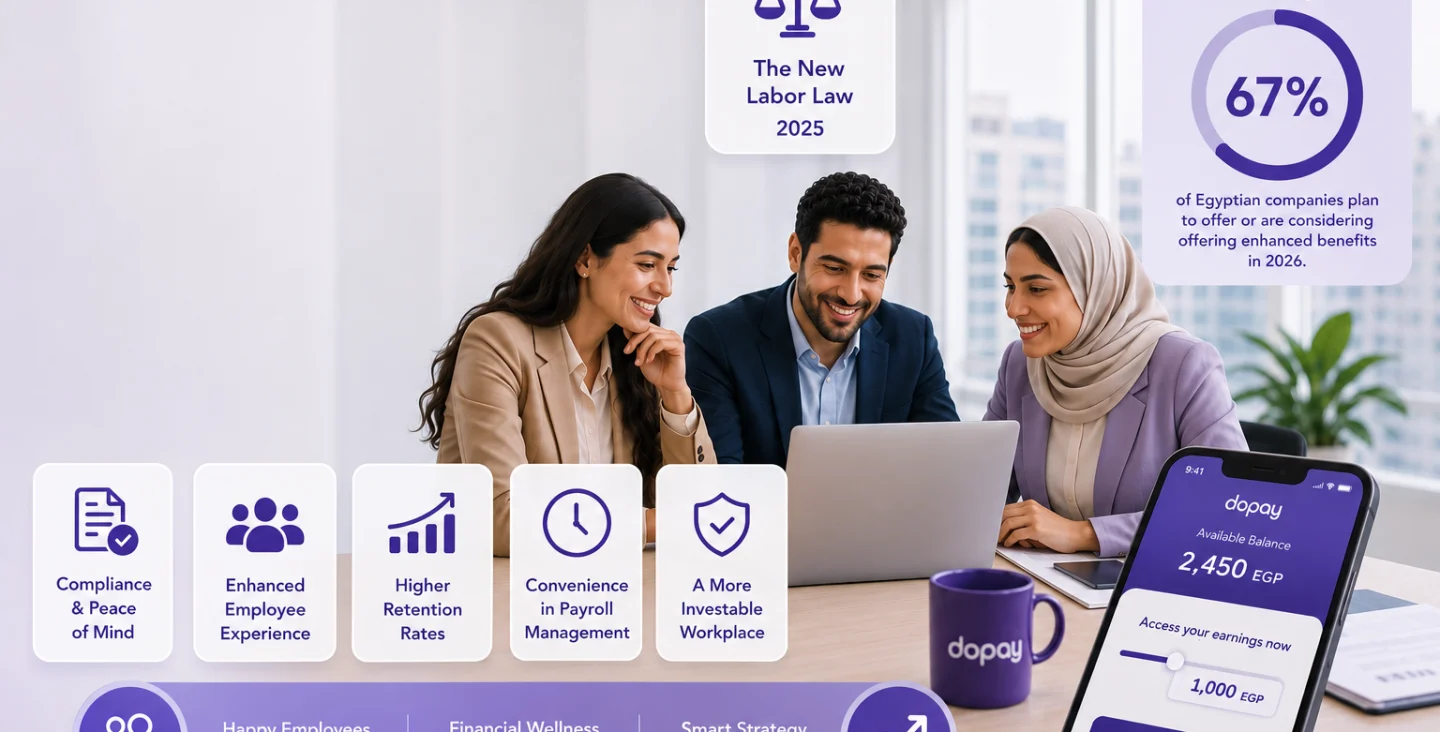
If you run HR at a mid-market company in Egypt, you’ve definitely noticed that the 2026 trends that matter aren’t the ones year-end listicles predicted. The real changes sit closer to your monthly cycle: wage-floor compliance after the 2025 labor law, frontline staff payroll going digital, earned wage access entering the benefits set, and compliance shifting from quarterly cleanup to monthly consolidation.
We’ve investigated what HR managers and talent directors across our customer base are actually changing this year and grouped it into six modifications that hold up at mid-market scale.
IN SHORT
The HR trends in Egypt 2026 that mid-market companies are actually implementing fall into six patterns: wage-floor pressure from the 2025 labor law, frontline staff payroll going digital, earned wage access as a retention tool, wage-compression in textiles and hospitality, HR data unifying around payroll, and compliance shifting from quarterly cleanup to monthly consolidation. And although AI in HR is widely discussed, it is least implemented at this scale.
THE PATTERN
What are the HR trends in Egypt 2026 that mid-market companies are actually acting on?
Six HR shifts are showing up consistently across mid-market companies in Egypt in 2026: wage-floor compliance, frontline staff payroll digitization, earned wage access uptake, retention pressure after wage compression, HR data unifying around payroll, and a move from quarterly to monthly compliance reporting. At this scale, heavily integrating AI into HR remains aspirational.
Mid-market HR in Egypt sits in a particular spot in 2026: big enough to feel every regulatory change, small enough that one person often is responsible for payroll, compliance, and talent all at once. The trends that matter are the ones that change daily operations, not the ones that headline a keynote.
According to the International Labour Organization, informal employment in Egypt sits above 60% of non-agricultural employment, so most mid-market HR teams manage a workforce that mixes formally registered staff with contracted or seasonal workers. Recent figures from the Central Bank of Egypt (CBE) show financial inclusion climbing toward 70% once mobile wallets and bank accounts are counted together. That climb is the backdrop for every wage-related trend on this list.
Across the businesses that have partnered with dopay in 2025 and 2026, the same six shifts keep showing up almost everywhere. They’re not predictions. They’re what HR managers and finance directors at mid-market companies are putting on the operational roadmap this year.
Do these shifts match what your team is already changing?
WAGE FLOOR
How is the 2025 labor law changing wage-floor planning in 2026?
The 2025 labor law and the EGP 7,000 private-sector minimum wage have pushed wage-floor planning from an annual budget exercise to a continuous compliance task. Mid-market HR teams are revisiting wage bands, formalizing informal arrangements, and documenting the basis for every pay slip more carefully than before.
The most evident 2026 shift in Egyptian HR sits at the wage floor. The minimum wage of Egypt’s private-sector rose to EGP 7,000 effective March 1, 2025, and Law 14 of 2025 codified a broader set of employer obligations around documentation, contract registration, and end-of-service packages. Wage-floor planning isn’t an annual budget exercise anymore. It has become a continuous compliance task that affects every pay slip.
For mid-market companies, the practical work is twofold. Wage bands need recalibration to ensure the base sits comfortably above the legal minimum, including roles that used to sit just above the prior threshold. And informal arrangements that used to be recorded in side-letters or cash supplements now need to be formalized into the payroll register, because the documentation expectation reaches further than before.
CAPMAS Labor Force Survey data shows formally registered employment growing through 2024 and 2025. That lines up with what we keep seeing: more of the workforce is moving into the formal register, and the register itself has to do more work. dopay for Business handles the documentation side by keeping every payroll row timestamped and reconcilable, which is what the new law’s evidence requirement asks for.
FRONTLINE DIGITAL
Why is digital payroll finally reaching the frontline workforce this year?
Digital payroll for white-collar employees in Egypt has been standard for a decade. The 2026 shift is that mid-market companies are extending it to the frontline: factory floors, hotel housekeeping, retail branches, and security teams. Payroll cards and mobile wallets are doing the work that bank accounts could not.
For most mid-market HR teams in Egypt, digital payroll has been a half-finished project. Office staff have been paid by transfer for years. The frontline workforce—especially in manufacturing, hospitality, and security—has often stayed on cash, because bank-account opening was slow and the workforce moved too quickly to keep accounts current.
2026 is the year that gap closes for the mid-market. According to the World Bank Global Findex Database, bank-account ownership in Egypt sits around 27% of adults 15 years and older, while the CBE counts overall financial inclusion near 70% once mobile wallets are included. The conclusion most HR leads reach is straightforward: rather than waiting for frontline workers to open bank accounts, it’s better to bring an account to them through a payroll card or a wallet.
Across the manufacturing, hospitality, and retail businesses on dopay, this move runs the same way each time: the HR lead identifies the staff currently paid in cash, our delivery and onboarding teams handle card production and in-person activation at the workplace, and the first digital payday lands within the same 30-day window. The result? Payroll work that used to block the HR lead’s calendar each month moves to our delivery and onboarding teams, and payday stops being a cash event.
EARNED WAGE ACCESS
How is earned wage access moving into mid-market benefits sets?
Earned wage access in Egypt has moved from curiosity in 2023 to a benefits-set item in 2026. Mid-market HR teams are adopting it as a retention tool that cuts salary-advance requests and supports employees through mid-month gaps without touching company cash flow.
Earned wage access, or EWA, lets employees draw on a portion of the salary they’ve already earned, before the regular payday. The concept isn’t new in international HR. It’s new in mid-market Egyptian benefits sets, and 2026 is the year it’s moved from a pilot phase to standard practice for many of the companies we work with.
The driver isn’t just employee demand, which has always been there. It’s the operational fact that traditional salary advances put pressure on HR and finance at exactly the wrong moment. ILO research on emerging-market wage cycles shows mid-month liquidity gaps are one of the strongest predictors of attrition in frontline roles. Earned wage access closes that gap without an HR approval queue and without affecting the employer’s balance sheet.
Within our customer success conversations at dopay, the HR managers who’ve added EarlyPay to their payroll setup describe the change as quiet. Salary-advance emails stop. The accounting team stops processing ad-hoc disbursements. The benefit appears on the pay slip as access to money already earned, which is automatically deducted on the next payday. This keeps everything within payroll regulation, not separate credit.
EarlyPay (اقبض بدري) is available to employees whose employer is already a dopay for Business customer. It cannot be acquired by individuals or by employers standalone.
RETENTION PRESSURE
Where is retention pressure landing hardest after wage compression?
Wage compression after the 2025 minimum-wage adjustment has hit the textiles, hospitality, and parts of retail industries the hardest, because the gap between entry-level and supervisory pay narrowed sharply. Mid-market HR teams in these sectors are seeing the highest turnover and the strongest pressure to rebuild the differential.
When a minimum wage rises significantly, the differential between entry-level and the next two or three rungs above it compresses. That’s the 2026 retention story in Egyptian mid-market HR, and the sectors feeling it most are textiles, hospitality, and parts of retail. The supervisor who used to earn comfortably above the line cook now earns only marginally more.
Federation of Egyptian Industries reporting through 2025 noted the compression in labor-intensive manufacturing, with textiles flagged as most exposed. CAPMAS sector data shows hospitality absorbing seasonal peaks with thinner middle layers than before. The HR response has been to rebuild the differential through non-wage levers: predictability of pay, access to earned wages between paydays, and clearer career paths within the same outlet or factory.
From on-ground experience, the companies that stabilize retention fastest combine three changes in the same quarter: a wage-band recalibration that restores the supervisory differential, a move to digital payroll so pay arrives reliably on a known day, and an earned wage access benefit that takes mid-month pressure off the team. Across hospitality customers on dopay, that combination shows the strongest impact in the second and third quarters after rollout.
DATA UNIFICATION
How are HR data systems unifying around the payroll record?
Mid-market HR teams in Egypt have spent years stitching headcount, time tracking, vacation and leave data, and payroll data across four or five systems. The 2026 shift is treating the payroll register as the single source of accurate information, with other HR data feeding into and out of it rather than sitting separately.
A typical mid-market HR toolset in Egypt has accumulated over five years: a spreadsheet headcount sheet, a time-tracking tool, a leave system, a separate payroll platform, and often a benefits administrator. Each holds part of the truth about each employee. Reconciling them at month-end has been the sneaky operational tax on every HR team at this scale.
The 2026 move is to anchor that toolset on the payroll record. Payroll is the system that has to be correct, timestamped, reconciled against the bank statement, and ready to produce evidence on demand. KPMG and Deloitte MENA HR survey work through 2024 and 2025 flagged this anchoring shift as the most consistent pattern in mid-market HR design across the region.
Talking to HR managers in mid-market hospitality and manufacturing every week, the request that comes up most is a way to stop reconciling four systems at month-end. The dopay for Business payroll register handles that anchor role because every change to headcount, contract, or wage band lands in the same timestamped record that disburses the salary. The comparison below summarizes what shifts.
| HR data step | Fragmented systems | Payroll-anchored system |
| Source of headcount truth | Spreadsheet, updated manually | Payroll register, live |
| Wage-band changes | Updated in HR doc, retyped into payroll | Updated once, flows to the pay slip |
| Month-end reconciliation | Four systems checked against each other | Bank statement against the register |
| Audit evidence on demand | Gathered from multiple sources | Pulled from one timestamped record |
| Reporting cadence | Quarterly cleanup before submission | Monthly hygiene, ready when asked |
 Guide
Guide

 Blog
Blog