Guide
Guide

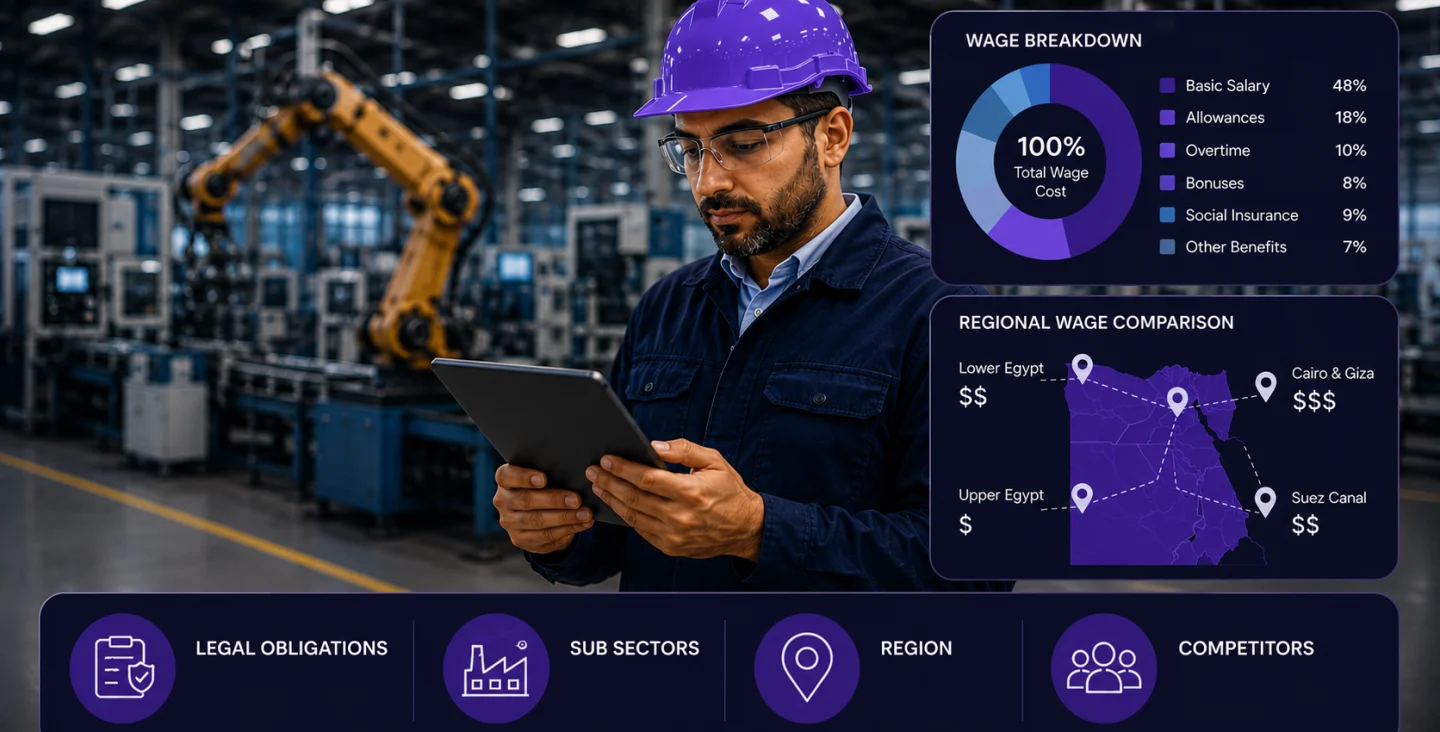
When you plan the 2026 wage review for your factory staff, the bands you set this quarter shape the margin for the year, and they have to hold against the factory next door without breaking the model. The minimum wage across the private manufacturing sector in Egypt in 2026 sits on a EGP 7,000 benchmark, with role-by-role bands climbing to two or three times that figure for foremen and certified maintenance technicians.
We’ve put together a 2026 reference for SME factory owners and operations directors, with what sits on top of base pay, where the regional gaps actually fall, and how to anchor bands against real public data instead of estimations.
IN SHORT
Egypt’s 2026 factory wages start at the EGP 7,000 statutory floor for line work and rise through line lead, machine operator, quality inspector, maintenance technician, warehouse, supervisor, and foreman bands. Cairo, Delta, Upper Egypt, and the Suez Canal Economic Zone each shift the bands. Overtime, production bonus, transport, and meal allowances typically add 15–35% on top of the base salary. The reference tables and the 2026 planning notes below give you a starting point, not a final answer.
THE LEGAL FLOOR
What is the legal floor for manufacturing wages in Egypt in 2026?
The minimum wage in Egypt is set by the National Council for Wages (NWC) and re-decreed periodically. The current floor of EGP 7,000 per month gross was announced in early 2025 and remains the reference for private-sector employers heading into 2026. Any role on a factory payroll register sits at or above this figure for a standard full-time month.
The floor matters more for some sub-sectors than others. Ready-made garment and textile factories have historically anchored line-worker pay close to the statutory minimum, with production bonuses adding the rest. Metal, automotive parts, and chemicals usually sit well above the floor by default because the work itself requires more skill. International Labour Organization data on Egypt indicates that informal employment has long sat above 60% of non-agricultural employment, which is part of why the official floor only partly describes what workers actually take home.2
For an SME factory owner setting 2026 bands, the floor is the easy part. The harder question is what the band ABOVE the floor should look like for each role, in each region, so the wage holds against other factories in the market without breaking the margin model.
ROLE-BY-ROLE BANDS
What do role-by-role pay bands look like for an Egyptian factory in 2026?
Typical 2026 monthly gross base bands in Egyptian manufacturing run from around EGP 7,000 for line workers to EGP 22,000 or higher for foremen and certified maintenance technicians. Skilled-trade roles, quality inspection, and machine operation sit in the middle. The bands below are planning estimates from recruitment-market signals, not legally-binding figures.
Egyptian factory pay bands are not published as a single official table. The Central Agency for Public Mobilization and Statistics (CAPMAS) publishes average weekly wages by sector in the Labour Force Survey, but role-level bands by sub-sector and governorate are not in any public dataset. The table below is built from recruitment-market signals, Federation of Egyptian Industries member reporting, and the patterns we keep seeing across the manufacturing businesses on dopay. Treat the ranges as a planning starting point, not a benchmark to anchor a contract against.
| Role | Typical 2026 base (EGP/month gross) | Sub-sector skew |
| Line worker (entry, unskilled) | 7,000 to 8,500 | Textile anchors at floor |
| Warehouse / stores assistant | 7,500 to 9,500 | Even across sub-sectors |
| Machine operator (semiskilled) | 9,000 to 13,000 | Metal and food = premium |
| Quality control / inspector | 10,000 to 15,000 | Food and pharma = higher |
| Line lead (working supervisor) | 11,000 to 15,000 | Even across sub-sectors |
| Maintenance technician (certified) | 12,000 to 20,000 | Metal and chemicals = top |
| Production supervisor | 14,000 to 20,000 | Even across sub-sectors |
| Foreman / shift lead | 16,000 to 22,000 | Metal and SEZONE = top |
| QC / production manager (junior) | 22,000 to 35,000 | Sector-led, SEZONE = premium |
Please keep in mind a few things while referring to this table. The bands are gross base monthly, before adding overtime, bonus, and allowances. These figures assume a Greater Cairo / 10th of Ramadan reference; Delta and Upper Egypt figures usually sit at a lower mark, and the Suez Canal Economic Zone (SEZONE) usually sits above for skilled roles. Sub-sector skew matters: a quality inspector in a pharmaceutical line sits closer to the top of the QC band than the same role in a small garment factory. The numbers are planning estimates from market signals, not contractual benchmarks.
REGIONAL DIFFERENCES
How do wages shift across Cairo, the Delta, Upper Egypt, and the SEZ?
Greater Cairo and the 10th of Ramadan industrial zones typically pay the highest blue-collar bands. Delta governorates sit slightly below, and Upper Egypt sits even lower. The Suez Canal Economic Zone (SEZONE) often runs above Cairo for skilled roles because exporters compete for the same pool. Treat regional skew as a planning range, not a fixed multiplier.
Egypt’s industrial map is concentrated in a few corridors. Greater Cairo, 10th of Ramadan, 6th of October, and Borg El Arab outside Alexandria carry the bulk of formal manufacturing employment. The Delta has a second concentration around Gharbia and Sharqia, predominantly textile and food processing. Upper Egypt has historically had lower formal manufacturing density. The SEZONE has scaled fast over the past five years as exporters and foreign-investment projects ramped up.
Geography significantly influences pay ranges. The pattern we keep seeing across the manufacturing businesses that have partnered with dopay is roughly this: take the Greater Cairo band as a reference point, subtract 5–15% for the Delta region, subtract another 5–15% for Upper Egypt, and add 5–20% for the SEZONE on skilled and supervisor roles. The unskilled bands compress because the EGP 7,000 floor sets the same minimum everywhere. The skilled bands stretch because skilled labor moves toward the higher-paying corridor.
For a SEZONE factory, the implication is direct: a maintenance technician you can hire in the Delta region at the low end of the band often costs you 15–20% more inside the zone, because the export-oriented neighbors are bidding for the same person. For an Upper Egypt factory, the implication is the opposite: the band sits lower, but recruiting a certified technician at all is harder, and the cost of bringing one in from Cairo (housing, transport, retention) can equalize most of the saving.
Here is a peek into how the regional band typically falls for a single role.
Typical 2026 monthly base for a certified maintenance technician, by region:
| Region | Typical base (EGP/month gross) |
| SEZONE | 14,000 to 22,000 |
| Greater Cairo / 10th of Ramadan | 12,000 to 20,000 |
| Delta (Gharbia, Sharqia) | 10,500 to 17,500 |
| Upper Egypt | 9,000 to 15,000 |
Those figures are planning estimates only, built from Federation of Egyptian Industries sector signals and dopay’s manufacturing-customer pattern across regions. Bands are gross base monthly, before adding overtime, bonus, or allowances to base pay.
SUB-SECTOR SKEW
How do textile, food processing, and metal sub-sectors compare?
Textile and ready-made garments anchor near the EGP 7,000 floor for line work and rely on production bonuses for take-home pay. Food and beverage (F&B) processing pays a small premium for hygiene and HACCP-trained roles. Metal, automotive parts, and chemicals sit highest because certified maintenance and machine operation drive the bands.
The sub-sector often matters more than region when it comes to setting wage models. Two factories two streets apart in 10th of Ramadan, one in ready-made garments and one in automotive parts, will run different wage models. The garment factory anchors line workers at or near the statutory floor, then layers a piece-rate or production-bonus structure that raises the take-home figure for the fast operators. The automotive factory anchors line workers above the floor by default and pays a meaningful premium for certified roles. The sector reports of the Federation of Egyptian Industries document the deviation in the underlying skill mix.
F&B processing sits between the two. Hygiene certification, HACCP training, and cold-chain handling all earn a band uplift. The supervisor band in food processing often runs at the top of the cross-sector range because retention is harder, with seasonal peaks around Ramadan and summer compressing the labor market. Pharmaceuticals sit even higher, but the SME pharma segment is small compared to multinational subsidiaries.
For an SME owner setting bands across multiple sub-sectors, the practical lesson is to anchor each band on the sub-sector first, then adjust depending on region. Anchoring on region first tends to under-pay the certified roles in the SEZONE and over-pay the line workers in Upper Egypt textiles.
FROM THE FIELD: WHAT WE SEE ON THE GROUND
Across the manufacturing businesses that have partnered with dopay, the bands SME owners actually set tend to cluster in the middle of the public ranges. The owners who set wages at the top of the range typically have a single skilled-trade bottleneck (one certified electrician, one specialty machine operator, etc.) and pay above-market to keep them. The owners who set wages at the bottom typically have high turnover in those same roles and rebuild the team every six to nine months. The middle of the band, paired with a predictable bonus on top, is where retention holds.
ON TOP OF BASE
What sits on top of the base wage in an Egyptian factory?
Wages at an Egyptian factory usually carry five things on top of base pay: overtime, production or attendance bonus, transport allowance, meal allowance or on-site canteen, and an annual bonus tied to output. Together, these add-ons typically lift gross monthly pay by 15–35% above base pay, which is why benchmarking on base pay alone is misleading.
Base pay is one line on the pay slip. The rest of what a factory worker takes home each month usually sits in a handful of recurring categories, each with its own rules and its own way of slipping through the audit trail if the payroll register does not catch them.
| Add-on | Typical pattern in Egyptian factories |
| Overtime | Paid at the statutory premium over the hourly equivalent of base pay; commonly runs at 10–25% of base for line and operator roles in peak months. |
| Production or attendance bonus | Output-linked for line workers, attendance-linked for support roles; typically 5–15% of base pay, sometimes higher in garment piece-rate models. |
| Transport allowance | Flat monthly figure or factory bus; the flat figure is often EGP 500–1,500, depending on commute distance. |
| Meal allowance or canteen | On-site canteen at zero or subsidized cost, or a flat allowance; equivalent value is commonly EGP 300–800 per month. |
| Annual or biannual bonus | Tied to factory output or to feast-day cycles; commonly equivalent to one–two months of base pay, paid in one or two tranches. |
The add-ons matter for two reasons. First, they shape what the worker actually takes home, which is the figure that drives retention. A line worker on EGP 7,500 base pay who takes home EGP 9,500 with bonus and overtime experiences a different job from one on the same base pay who clears EGP 7,800. Second, they shape the audit trail. Bonuses and allowances paid in cash or off register are the most common reason payroll reconciliation breaks at year end. With dopay for Business, base, overtime, bonus, transport, and meal allowance can all be recorded in one register and one monthly statement per employee.
For SME owners benchmarking against the factory next door, the practical lesson is to compare gross monthly take-home, not base wage. Two factories with the same base pay can run a 25% gap in take-home income once the add-on structure is calculated and implemented.
2026 PLANNING
How do you build 2026 wage bands that hold against the factory next door?
A 2026 band review starts with the statutory floor, layers in sub-sector and region, and finishes with the add-on structure each role expects. Most SME factories now run two reviews per year instead of one, with a mid-year check around any new National Council for Wages decree or major EGP exchange-rate shift.
Inflation in 2024 and 2025 broke the once-a-year band review for most SME factories we work with. Owners who previously set a wage band in January and held it for 12 months found themselves losing skilled workers to neighboring factories that re-priced in June. The pattern that holds up at SME scale is a January band-set plus a June check-in, with a fast adjustment window if the NWC issues a new decree or the EGP moves sharply.
For SME owners and operations directors, the practical sequence we see working is roughly: anchor each role on the statutory floor, layer the sub-sector band, layer the regional adjustment, layer the add-on structure, and, finally, compare against the actual offers your HR lead is making and losing in recruitment. The last step is the one that catches the gap between what the public ranges suggest and what your local recruitment market is actually paying.
For the band itself, transparency inside the factory tends to do more for retention than a small uplift at the top. Across the manufacturing businesses on dopay, the pattern we keep seeing is that workers who can see their own base, overtime, bonus, and allowance on one statement raise fewer disputes and ask for fewer ad-hoc advances than workers who get a single cash envelope each month. The band model and the payroll mechanics are connected.
The same logic applies to construction and contracting teams on rotating sites, where wage bands have to hold against the next project site as well as the next factory. Manufacturing just runs the cycle inside one location, which is the easier of the two in terms of operational challenges.
PAYROLL MECHANICS
How do you pay 50 or more factory workers without the cash logistics?
Paying 50 or more factory workers in cash means drawing a large sum on a known day, counting it on-site, and getting a signature on a sheet that never quite matches the pay slip. Moving the cycle onto a digital register removes the cash exposure, gives every worker an account from day one, and keeps the audit trail on one statement.
Cash payday carries an operational tax that is rarely on the budget line. Someone has to withdraw the cash. Someone has to count it. Someone has to sit with each employee and walk them through the content of envelope. Someone has to file the signature sheet. The day costs hours that day-to-day operations need.
It also blocks the audit trail your wage-band work depends on. If base pay, overtime, bonus, transport, and meal allowance arrive in one envelope, the worker cannot see which line moved, and your CFO cannot reconcile the run against the bank statement. According to the World Bank Global Findex Database, around 27% of Egyptian adults aged 15 and over held an account at a financial institution. More recent figures from the Central Bank of Egypt show financial inclusion climbing toward 71% when mobile wallets are counted alongside bank accounts. A meaningful share of any factory’s headcount still does not have a bank account on the day they are hired.
With dopay for Business, the monthly cycle moves to a digital register that disburses straight to a dopay account or a dopay card for workers who do not yet have one. Our on-the-ground logistics teams handle card production, on-site delivery, and in-person activation for workers who have never held a bank account before. Our 24/7 customer care teams in Cairo answer activation questions in Arabic and English, so onboarding does not pull a supervisor off the line.
For factory owners managing 50–500 workers, the practical pattern we keep seeing is a first payday within 30 days, with card delivery for the workers who don’t yet have a bank account running in parallel to the register setup. Each worker then sees a single statement with base, overtime, bonus, transport, and meal allowance broken out, which is the same evidence your accountant pulls for the next audit.

 Blog
Blog